Behind the Scenes of
Two-Home Families:
Co-Parenting
10 Articles: Applied frameworks from clinical practice, training, and lived systems
When blame takes over, problem-solving stops.
Clinicians can teach coping skills all day long. If the system a child lives in does not change, those skills will not be enough. Living in two homes is not just a childhood experience. It is a family system that requires support, not simply a child who needs better coping strategies.
This series looks beneath blame to understand how two-home family systems actually function, and how well-intended co-parenting styles can unintentionally pull children apart. The articles explore patterns that quietly shape children’s experiences in two-home families, patterns that are often invisible to adults, courts, and even well-trained professionals.
Using applied frameworks drawn from clinical practice and training, these pieces translate real-world system dynamics into clear, usable language that helps families and professionals reduce conflict, protect children’s mental health, and work with systems as they actually function.
Author: Stephanie Sternes, LMFT, LCPC
Publisher: Healing Story Ranch
Year: 2024-2025
Category: Practitioner Frameworks | Two-Home Family Systems
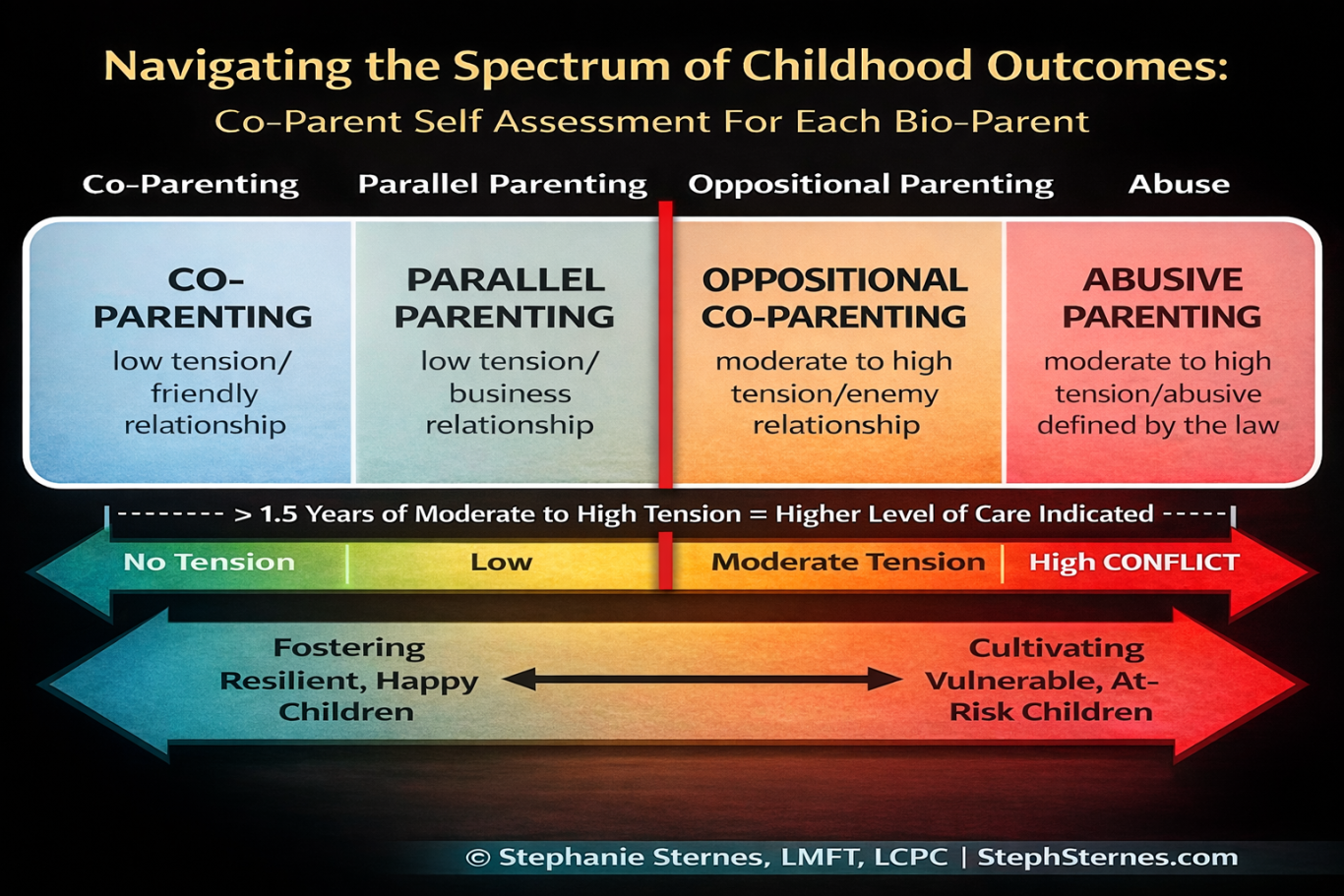
Article 1: The Co-Parenting Spectrum: From Collaboration to Harm
When parents separate, parenting does not end. It reorganizes.
In two-home families, the way parenting reorganizes over time matters as much as any individual decision. Through years of clinical work, predictable patterns emerge. These patterns tend to fall along a co-parenting spectrum, ranging from collaborative and child-focused to oppositional and harmful.
At one end of the spectrum, co-parenting reflects shared commitment to the child, respectful communication across households, and flexibility as children grow and develop.
When cooperation becomes difficult, many families move into parallel parenting. Contact is limited. Boundaries are clearer. While not ideal, parallel parenting can be protective when conflict cannot be safely resolved.
Further along the spectrum, families may slide into patterns that quietly place children in the middle of adult differences, including oppositional co-parenting and, in more severe cases, abuse. These patterns are rarely intentional. They develop as systems adapt under pressure. Without intervention, these binds tighten over time.
Oppositional Co-Parenting is an applied clinical construct developed by the author through clinical practice, professional training, and consultation with two-home family systems.
When Blame Takes Over, Problem-Solving Stops
When adults blame the other household, the brain shifts out of problem-solving mode.
Blame narrows attention. It activates threat responses rather than curiosity. Once the brain organizes around fault, it becomes focused on defending a position instead of understanding patterns. In two-home families, this shift happens quickly and often without awareness.
When one household is framed as the problem, the system moves into opposition. Communication tightens. Flexibility decreases. Parenting decisions become reactions rather than reflections. What follows is not collaboration, but relational warfare.
Rather than asking how parenting styles interact across homes, adults focus on proving who is right. Rather than noticing how children are being pulled between worlds, energy is spent managing blame. The system locks into opposition, and children absorb the cost.
The Love–Loyalty Paradox
The Love–Loyalty Paradox is an applied clinical construct describing family systems in which loyalty functions as a substitute for love.
In these systems, belonging is secured through alignment rather than attachment. Emotional closeness depends on agreement. Safety depends on sameness. What appears to be love is often allegiance, and what appears to be resistance is frequently protection.
The paradox emerges because loyalty can feel stabilizing to adults while being constraining for children. When loyalty becomes the primary glue holding a household together, children learn that connection is conditional. Differences in feelings, preferences, or experiences across homes carry relational risk.
Within two-home families, the Love–Loyalty Paradox often intensifies oppositional co-parenting. Households may seek loyalty rather than shared understanding. Parenting decisions become symbolic, reinforcing alignment instead of supporting development.
Children caught in this paradox are not rejecting relationships. They are preserving them. Their behavior reflects adaptation to systems where love is experienced as contingent on loyalty.
Naming the Love–Loyalty Paradox allows adults and professionals to shift attention away from compliance and toward connection. When love no longer requires loyalty tests, children gain freedom to belong fully in both homes.
Impact on Children
Children experience these dynamics not as clarity, but as pressure.
Over time, being caught between opposed households places children in chronic relational strain. They are required to monitor, manage, and adapt to adult differences they did not create and cannot resolve.
Clinically, this type of ongoing bind is associated with increased risk for anxiety and depressive symptoms in childhood, as well as adjustment difficulties and mood-related disorders that often intensify during adolescence. When children must consistently navigate loyalty, alignment, and emotional safety across homes, stress becomes chronic rather than situational.
What often begins as an effort to stabilize a child’s world increases mental-health vulnerability instead.
Clinically: A Practice Error
Treating Child Symptoms Without Addressing the System
One of the most common pieces of advice given to families in two-home systems is:
“Just keep your side of the street clean.”
This guidance is often well-intended. It encourages parents to regulate their own household and avoid escalating conflict. In some situations, this can reduce immediate tension.
However, in two-home family systems, this advice becomes a practice error when it replaces system-level intervention.
Children do not live on one side of the street. They live between households. When co-parenting opposition, misaligned rules, or unresolved loyalty binds remain intact, regulating one home does not dissolve the bind the child carries.
In these cases, focusing solely on one household unintentionally shifts responsibility for adaptation onto the child. Symptoms may quiet temporarily, but the conditions that created them persist.
Effective intervention requires recognizing when a child's distress reflects system strain rather than individual coping deficits. Supporting children means addressing the structure they live within, not only the skills they use to survive it.
A Pattern We Will Explore Next
One of the most common ways these system pressures take shape is through oppositional co-parenting, a pattern that develops when households organize in reaction to one another rather than around the child. This pattern is explored in depth in the next article.
Citation Note
The frameworks described in this article, including Oppositional Co-Parenting and the Love–Loyalty Paradox, are applied clinical constructs developed by the author through clinical practice, professional training, and consultation with two-home family systems. This work is informed by specialized training in stepfamily and co-parenting models, including the work of Patricia Papernow and Ron Deal.
References (APA-Style)
Papernow, P. L. (2013). Surviving and thriving in stepfamily relationships: What works and what doesn’t. Routledge.
Papernow, P. L. (2018). The stepfamily handbook: From dating, to getting serious, to forming a “stepfamily”. Routledge.
Deal, R. (2014). The smart stepfamily: Seven steps to a healthy family (Rev. ed.). Bethany House.
Deal, R., & Chapman, G. (2014). Building love together in blended families. Bethany House.
Ganong, L., Coleman, M., & Sanner, C. (2019). What works in stepfamilies. Springer.
Kelly, J. B., & Emery, R. E. (2003). Children’s adjustment following divorce: Risk and resilience perspectives. Family Relations, 52(4), 352–362.
Article 2
Oppositional Co-Parenting Styles: How Well-Intended Co-Parenting Approaches Pull Children Apart
A Brief Bridge from Article 1
In Article 1, we introduced the co-parenting spectrum and explored how two-home family systems reorganize over time. We examined how blame shuts down problem-solving, how loyalty can replace love as the glue holding families together, and how children absorb the cost of adult misalignment.
This article builds on that foundation by examining one of the most common and most costly ways these dynamics take shape in practice: oppositional co-parenting styles.
Oppositional Co-Parenting is an applied clinical construct developed by the author through clinical practice, professional training, and consultation with two-home family systems.
What Oppositional Co-Parenting Styles Are
Oppositional co-parenting styles describe a system pattern in which households organize themselves in opposition to one another rather than around the child’s developmental needs.
This pattern rarely begins with hostility. It almost always begins with concern.
One household notices a child struggling and responds by increasing structure, household rules, or expectations. The other household experiences this shift as judgment, control, or threat and responds defensively by protecting its own style or authority. Over time, parenting decisions become less about the child and more about opposing the other home.
Oppositional co-parenting styles sit between parallel parenting and overtly harmful dynamics. While not abuse, they can quietly create harm when left unrecognized.
This is the pattern that keeps families stuck. Oppositional co-parenting styles are common in repeat court cases, are a frequent pathway into resistance–refusal dynamics, and are associated with the poorest mental-health outcomes for children, including elevated risk for suicidality. If we want different outcomes, we have to treat the co-parenting system, not just the child’s symptoms.
Research Context: Why This Matters
1. The Court Truth: A Minority of Families Drive Repeated Litigation
Divorce and family-court research consistently identifies a relatively small subgroup of separated parents (often estimated in the range of 10–20 percent) who remain in chronic, high-conflict co-parenting patterns over time. Although a minority, this group accounts for a disproportionate share of repeated court involvement and professional system strain across a child’s development (e.g., Johnston, Kelly). These are the families that are more likely to show up in counseling offices. They are different from other 1st home, or 1 home families.
2. Chronic Co-Parenting Opposition and Resistance–Refusal Dynamics
Research on resistance–refusal dynamics (sometimes described as parent–child contact problems) consistently shows these patterns emerging most often in high-conflict, litigated co-parenting systems. Children caught in these disputes face elevated risk for emotional distress and maladjustment (e.g., Greenberg; Álvarez).
From a systems perspective, oppositional co-parenting styles help explain why. When two households organize against one another, children are pressured to resolve impossible relational binds. Over time, avoidance and refusal may become strategies for reducing internal conflict and restoring a sense of safety. Unfortunately, picking sides results in the loss of a meaningful connection with one side of the family.
3. Mental Health and Suicide Risk
A substantial body of research links chronic interparental conflict and post-separation family dysfunction with the poorest mental-health trajectories for children and adolescents, including elevated rates of anxiety, depression, and mood disorders (e.g., Brock et al.; van Dijk et al.).
Research also links family dysfunction following separation or divorce with increased risk for suicidal thoughts and behaviors across adolescence (e.g., Edwards et al.; Pu et al.; Xu et al.). These findings reinforce why system-level intervention matters, not just individual coping skills.
Clinical translation: Oppositional co-parenting styles are not merely communication problems. They are high-risk system structures that predict long-term court involvement, increase the likelihood of resistance–refusal dynamics, and elevate mental-health risk across a child’s developmental lifespan.
How Oppositional Co-Parenting Develops
Oppositional co-parenting does not require two rigid or extreme households. In many families, it develops asymmetrically. One home may shift into opposition first, while the other initially does not. In other cases, both households gradually organize in reaction to one another. If not interrupted, the bind continues to tighten until it breaks.
The pattern is defined less by intent and more by relational positioning.
One Home, Not the Other
In some families, one household becomes oppositional when a parent perceives the other home as inconsistent or insufficiently structured and responds by increasing rules, discipline, or expectations.
Although the other household may not initially reciprocate, defensive reactions often emerge over time. Parenting decisions begin to reflect protection rather than intention. As each home adjusts in response to the other, opposition deepens across the system.
Children experience this dynamic not as clarity, but as pressure. Over time, being caught between opposing households places children in chronic relational strain. Clinically, this type of bind is associated with increased risk for anxiety, depressive symptoms, adjustment difficulties, and mood-related disorders that often intensify during adolescence.
When Both Homes Become Oppositional
In other families, oppositional co-parenting develops on both sides. Each household responds with increasing certainty, control, or defensiveness. Communication becomes reactive. Parenting decisions become symbolic rather than developmental.
At this point, the child is no longer navigating two homes. They are navigating a relational standoff.
Common Pathways into Oppositional Co-Parenting
Oppositional co-parenting styles most often develop through predictable system stressors, not individual pathology.
Some of the most common pathways include the following:
Differing Family System Structures: A frequent source of opposition arises when households operate from fundamentally different organizing principles. For example, one home may function within a more matriarchal system, a household in which the mother holds primary relational, emotional, and decision-making authority, and male parents or partners are minimally involved in daily parenting or excluded from shared caregiving roles. Parenting responsibilities, rules, and values are not jointly negotiated but are centrally determined. The other may operate from a more traditional or hierarchical structure, emphasizing roles, rules, and compliance. Neither structure is inherently harmful. Problems emerge when these differences are interpreted as deficits rather than differences. Parenting decisions then become corrective rather than responsive. Children are left navigating the push and pull of right or wrong systems.
“Providing What’s Missing”: In many oppositional co-parenting systems, well-intended adults attempt to meet what they perceive as a child’s unmet needs across households. When one home is experienced as permissive or inconsistent, the other may respond by increasing structure, expectations, or household rules. Stepparents are particularly vulnerable to being pulled into this role, often assuming responsibility for order or follow-through before the broader system can support it. While motivated by care, these efforts frequently escalate oppositional co-parenting by organizing households in reaction to one another rather than around the child. What is intended as support becomes contrast. What is intended as stability becomes alignment pressure. Children experience this not as increased safety, but as a loyalty bind. Emotional security becomes associated with one home over the other, and children are exposed to managing the tension between them. Over time, many resolve this bind by withdrawing from the stricter household, sometimes escalating into resistance or refusal.
Loyalty and Identity Threats: Oppositional co-parenting also develops when adults experience differences between homes as personal or moral threats. Parenting choices become tied to identity rather than function. In these cases, disagreement feels dangerous. Flexibility feels like loss. Children sense this tension and adjust their behavior accordingly, often protecting relationships rather than expressing needs.
Stress, Burnout, and Limited Capacity. Chronic stress, financial strain, unresolved grief from the separation, or new stepfamily transitions: All reduce a parent’s capacity for reflective decision-making. Under stress, systems default to rigidity. Opposition increases when adults lack support, time, or space to step back and assess the system as a whole.
Mental Health Strain in One or Both Homes: When one or both caregivers are managing untreated or under-treated mental health challenges, co-parenting flexibility often decreases. Anxiety, depression, trauma histories, or mood instability narrow tolerance for difference and heighten sensitivity to perceived threat. Under these conditions, parenting decisions are more likely to be reactive than reflective. Neutral differences are interpreted as danger or incompetence, increasing co-parenting opposition across homes.
Unresolved Pre-Divorce Relationship Injuries: Oppositional co-parenting styles often carry unfinished emotional business from the relationship that ended. Betrayal, abandonment, resentment, or unresolved power struggles may continue to shape interactions long after separation. In these systems, co-parenting becomes the place where old injuries are replayed. Parenting decisions are influenced as much by past wounds as by present child needs.
Fear-Based Parenting and Threat Responses: When one or both households experience the other primarily through fear, the nervous system shifts into fight, flight, or freeze. Problem-solving gives way to self-protection. From this state, parents no longer see the other household clearly. They see a threat. Parenting becomes rigid, avoidant, or controlling—not because of values, but because fear has replaced curiosity. Co-parenting opposition deepens as each home organizes against perceived danger.
Living Outside the Window of Tolerance: Chronic stress, physical illness, financial strain, caregiving overload, or burnout can push parents outside their window of tolerance. When regulation is compromised, systems default to survival mode. Parents become more reactive, less cooperative, and less able to hold nuance. Flexibility collapses. Opposition increases because nervous systems are overwhelmed, not because parents intend harm.
Gatekeeping, Rigidity, and the Fairness Trap: In some families, mistrust leads to increased gatekeeping. Over time, co-parenting becomes organized around enforcement rather than the relationship or the children. This often evolves into a fixation on “fairness,” where time, rules, and decisions must be exactly equal. The focus shifts from the child’s developmental needs to winning and losing. When fairness replaces attunement, co-parenting opposition hardens, and children’s needs are eclipsed.
Substance Use and Impaired Capacity: Substance in one or both households significantly increases the likelihood of oppositional co-parenting styles. Impaired judgment, inconsistency, and broken trust narrow the space for cooperation. Even when substance use is episodic or in remission, the system may remain organized around vigilance and control. Opposition persists because safety has been destabilized.
When Loyalty Replaces Love: One of the most powerful predictors of oppositional co-parenting styles occurs when one or both households organize around loyalty rather than love. This structure mirrors a well-documented psychological mechanism seen in high-control groups, where belonging is secured through alignment and maintained through threat of relational loss. In these systems, agreement becomes safety. Difference becomes threat. Children are not invited to attach freely across homes; they are required to demonstrate allegiance.
I refer to this household-level organizing pattern as the Love–Loyalty Paradox. It is not a loyalty bind, which reflects a child’s internal experience, but a systemic way of living in which loyalty becomes the primary glue holding the household together. In many ways, loyalty-organized households function similarly to enmeshed family systems. Boundaries are blurred, differentiation is discouraged, and connection is maintained through sameness rather than secure attachment. Within these systems, attachment is monitored, independence is experienced as betrayal, and shared attachment across homes is perceived as threat.
The Love–Loyalty Paradox deepens co-parenting opposition because loyalty-based systems cannot tolerate shared attachment. Clinically, this pathway is associated with the most entrenched conflict and the highest likelihood of resist–refuse dynamics.
This paradox and the cultural patterns that sustain it are explored in depth in the next article.
Oppositional Structural Role Displacement: An applied clinical construct describing a system pattern in which parenting roles and household authority become misaligned across homes, placing stepparents in positions the broader system cannot support.
This commonly occurs when one home operates from a more traditional or shared household structure, where adults collaborate over time on household rules and routines, and stepparents are gradually integrated into daily functioning. Verses the other home operating from a matriarchal or parent-centered structure, where one parent retains primary authority and household rules are not shared or enforced by a stepparent. This is an oppositional setup that can be identified by family cultural styles. It can come from other styles as well; this is just an example. Research and clinical experience consistently show that when stepparents assume authority over household rules too early, conflict increases. Over time, many stepfamilies do successfully integrate stepparents into shared household leadership once trust and attachment are established. This developmental progression is not always mirrored across households and then a deeper bind can drive co-parenting opposition.
From a systems perspective, the problem is not stepparent behavior. It is misaligned household roles and authority operating within an oppositional co-parenting structure.
When the Co-Parenting Foundation Is Broken Before Stepparents Enter In the author’s clinical experience, one of the most significant contributors to oppositional co-parenting styles is the absence of a functional co-parenting relationship before additional adult influence enters the system. Stepparents do not create instability. They expose it. Co-parenting is the load-bearing structure of two-home families. When that structure is unstable, everything built on top of it carries strain.
Each of these conditions increases reactivity and decreases the system’s ability to coordinate around the child.
A Clinical Position: Co-Parenting as the Primary Intervention Point
In the author’s clinical position, the co-parenting relationship is the most important intervention point in two-home family systems.
This does not require warmth, closeness, or emotional repair. It requires functionality, predictability, and child-centered coordination.
When co-parenting opposition remains unaddressed, individual therapy for children, parenting strategies within one home, or stepparent coaching alone cannot resolve system strain.
Clinically: A Practice Error
Focusing on the Child, Stepfamily, or Couple Without Assessing Co-Parenting Opposition
Clinicians are often advised:
“Just focus on the client in front of you.”
This guidance can be helpful when the broader system is stable. When the co-parenting system is organized around opposition, however, this approach is incomplete.
Stepparents enter systems shaped by existing co-parenting dynamics. Without assessing and addressing co-parenting opposition, focusing exclusively on the stepfamily or couple can unintentionally intensify system strain.
Impact on Children
Children living in oppositional co-parenting systems experience chronic relational strain. They must monitor adult emotions, manage transitions, and navigate conflicting expectations they did not create and cannot resolve.
Stress becomes ongoing rather than situational. What begins as an effort to stabilize a child’s world often increases emotional vulnerability instead.
Citation Note
Oppositional Co-Parenting Styles, Love-Loyalty Paradox, and Oppositional Structural Role Displacement are applied clinical constructs developed by the author through clinical practice, professional training, and consultation with two-home family systems. This work is informed by specialized training in stepfamily and co-parenting models, including the work of Patricia Papernow and Ron Deal.
References (APA-Style Starters)
Álvarez, F. (2022). Child-to-parent resistance–refusal dynamics: Conceptual clarification and practical implications. Papeles del Psicólogo.
Brock, R. L., et al. (2015). Interparental conflict, children’s security, and long-term risk of internalizing problems. Journal of Family Psychology.
Edwards, A. C., et al. (2024). Divorce, genetic risk, and suicidal thoughts and behaviors. Journal of Affective Disorders.
Greenberg, L. R., Doi Fick, L., & Schnider, R. A. (2016). Early intervention with resistance–refusal dynamics. Family Court Review.
Johnston, J. R. (1994). High-conflict divorce. The Future of Children.
Pu, M., et al. (2024). Family dysfunction and risk of suicidal behavior in adolescents. Journal of Affective Disorders.
van Dijk, R., et al. (2020). Interparental conflict and child adjustment after separation/divorce: A meta-analysis. Journal of Family Psychology.
Xu, L., et al. (2025). Interparental conflict and adolescents’ suicidal ideation. Frontiers in Psychiatry.

Article 3
When Loyalty Replaces Love:
The Love-Loyalty Paradox in Co-Parenting
The Most Dangerous Form of Oppositional Co-Parenting
A Brief Bridge from Article 2
In Article 2, we introduced Oppositional Co-Parenting; this alone does not explain why some families deteriorate more severely than others. To understand the most damaging outcomes, we must examine what happens when loyalty replaces love as the organizing force of the system.
The Breakfast Table
No one is yelling.
The table is set. The routine is familiar. The adults are doing what they believe is right.
A child sits quietly, choosing words carefully. Laughing a little less. Watching faces before answering. One home feels safer than the other, not because it is more loving, but because it is less complicated.
Nothing here looks like abuse.
And yet, something essential is being lost.
This is often how the most damaging form of oppositional co-parenting begins. Not with cruelty, but with triangulated alignment against one household.
The Oldest Story We Keep Telling
Long before parenting plans and court orders, loyalty kept humans alive.
Belonging meant safety. Exile meant danger.
In families under stress, this ancient survival system can quietly take over. When adults experience difference as threat, they seek alignment. When alignment becomes the price of connection, love changes shape.
Children learn this faster than anyone. Emotions speak louder than words. Nonverbal’s are processed faster than words.
Children learn what can be said.
They learn what must be protected.
They learn which relationships feel dangerous to mention.
And they can learn that neutrality is not allowed.
Naming the Pattern: The Love–Loyalty Paradox
The Love–Loyalty Paradox describes a family system in which loyalty replaces love as the primary organizing force in one or both homes.
In these systems:
- Belonging is secured through alignment
- Disagreement carries relational risk
- Attachment depends on allegiance
What looks like closeness is often loyalty enforcement.
What looks like rejection to one parent or stepparent is often self-protection.
Within two-home families, loyalty-based systems cannot tolerate shared attachment. When a child’s love for one home feels threatening to the other, opposition becomes inevitable.
This is why loyalty-driven opposition between homes is the most damaging form of oppositional co-parenting.
Why Loyalty Is Powerful and When It Becomes Dangerous
Loyalty itself is not harmful. Loyalty and affinity are natural, developmentally expected parts of family life. Children form attachments to parents, siblings, and caregivers as part of healthy identity development. These bonds are held together by love. Love allows difference. Love expands connection. Love does not require choosing.
In most two-home families, early loyalty binds are normal, temporary, and resolvable. When biological parents give children clear permission to love and be loved by all caregivers in both homes, love remains the glue that holds the system together. Children learn that connection is not a limited resource. More love strengthens development rather than threatening it.
Problems arise when loyalty replaces love as the primary glue holding a family system together.
Love helps children grow. Loyalty asks children to choose.
When love is the glue in a family, children are free to belong in all their relationships. When loyalty becomes the glue, children feel pressure to protect one relationship from another.
In these systems, belonging is no longer secured through attachment. It is secured through alignment. Agreement becomes safety. Difference becomes risk. Love becomes conditional and must be protected from the other household.
This form of loyalty is fundamentally different from healthy attachment.
Human groups under threat often organize around loyalty rather than love. Gangs, cults, and extremist movements rely on allegiance. Belonging is earned through sameness. Dissent is punished. Identity is protected through opposition. These systems are powerful not because they offer more love, but because they restrict where love is allowed to go.
In families, this mechanism is more subtle and more dangerous because it is wrapped in care. Children are not asked to pledge loyalty explicitly. They are asked to feel it. The cost of difference is not expulsion, but relational loss.
When loyalty replaces love as the organizing force, children lose the freedom to belong fully. What should be an expanding network of attachment becomes a narrowing channel of permission. This shift marks the point at which loyalty moves from protective to harmful and becomes a central driver of oppositional co-parenting and resistance refusal dynamics.
Why This Pattern Produces the Poorest Outcomes
Research consistently shows that:
- Chronic, high-conflict co-parenting systems account for repeated court involvement
- Resistance–refusal dynamics emerge most often in these systems
- Prolonged exposure to interparental conflict is associated with the poorest mental-health trajectories for children, including elevated risk for depression, anxiety, and suicidal thoughts across adolescence
From a systems perspective, the Love–Loyalty Paradox explains how these outcomes develop.
When love is contingent on loyalty, children are forced into impossible internal conflicts. Avoidance becomes relief. Silence becomes safety. Refusal becomes regulation.
This is not defiance.
It is an adaptation to an unresolvable bind.
Clinical Red Flags : See the image above with Love as the Glue (A Healthy Attachment) and Loyalty as the Glue (An Oppositional Alliance)
Clinical Interpretation
These patterns are not signs of preference, maturity, or clarity.
They are signs of relational threat.
In loyalty-based systems, children regulate relationships rather than emotions.
Clinically: A Practice Error
Mistaking Loyalty-Driven Distress for Choice or Pathology
One of the most damaging clinical errors in loyalty-bound systems is misinterpreting loyalty-driven distress as evidence of preference, alienation, or individual pathology.
When clinicians treat resistance or refusal as a child’s “choice,” or mislabel silence as resilience, they reinforce the very structure that is harming the child. Interventions that focus on correcting behavior, enforcing contact, or restoring compliance without addressing the loyalty instead of love-based system, increase pressure and deepen opposition.
In loyalty-bound systems, children are not choosing sides.
They are managing relational threat.
They are attempting to preserve attachment without losing themselves.
Effective intervention requires identifying and interrupting loyalty enforcement at the co-parenting system level. Responsibility must be placed where the structure exists, not where the symptoms appear.
Why Naming This Matters
The Love–Loyalty Paradox explains why:
- Some families cycle through court for years despite repeated intervention
- Some cases escalate even when services are in place and well-intentioned
- Some children deteriorate emotionally without an obvious precipitating event
- Some adolescents reach a breaking point after years of managing an unspoken relational threat
- And some families lose meaningful relationships with their children when loyalty to one home requires erasing love for the other
Without a name for this pattern, children are often misread as anxious, depressed, oppositional, avoidant, or disordered. Adults are framed as uncooperative or hostile. Interventions focus on behavior, compliance, reunification that doesn't work, or contact schedules while the underlying structure remains intact.
Naming the Love–Loyalty Paradox shifts attention away from children’s behavior and toward the system organizing their distress. It clarifies that estrangement may emerge not from rejection or pathology, but from a system in which love becomes organized around loyalty enforcement, often without conscious awareness by the parent experiencing closeness.
When loyalty replaces love as the organizing force, children are asked to solve conflicts they did not create and cannot resolve. Naming this pattern is not about blame. It is about protection.
When love no longer requires loyalty tests, children regain the freedom to belong fully, without fear.
For Clinicians
When a child’s behavior does not make sense, or one home is blaming the other, look for the relational threat the child is managing, not the diagnosis they have been given.
For Families
Children heal when they are allowed to love freely, not when they are asked to choose who they are allowed to love. This is inclusive of stepparents and stepfamilies. They are all a part of a child’s story.
For Courts and Parent-Forensic Systems
When loyalty rather than love becomes the organizing force of a family system, children may appear regulated only when aligned with one household. In other cases, particularly during adolescence, children may gravitate toward the more lenient or less demanding home and show increased dysregulation there, including school refusal, emotional collapse, or escalating mental-health symptoms.
In both patterns, alignment is often misinterpreted as preference, autonomy, or emotional safety. What is missed is the underlying structure: children are responding to loyalty enforcement, developmental pressure, and uneven expectations across homes, not freely choosing what is best for them.
Behaviors courts routinely assess, such as rigid gatekeeping, resistance to shared parenting, interference with contact, or deference to a child’s stated preference, are frequently understood as honoring choice rather than recognized as indicators of a system organized around opposition between households.
Identifying loyalty as the organizing force allows courts and professionals to assess why a child is aligning where they are, rather than assuming that alignment reflects health, safety, or genuine preference. This shifts attention from intent and blame to the structure shaping the child’s behavior.
For All Professionals
Systems do not change what they cannot see.
When the Love–Loyalty Paradox is not identified, families are often left without meaningful support until conflict escalates into the court system. By that point, patterns are entrenched, positions are hardened, and children have been carrying the strain for years.
Most families do not disengage because they do not care. They disengage because they do not see a workable path forward. Court involvement is expensive, time-consuming, and often inaccessible. Many parents step back not because they agree with what is happening, but because they cannot afford to keep fighting for structural change.
Professionals who work with families long before court involvement are often the only ones positioned to identify the Love–Loyalty Paradox early. Naming this pattern early allows families to address co-parenting opposition before it hardens and before children are required to manage conflicts that adults could have addressed sooner.
Early identification of the Love–Loyalty Paradox is not about blame or escalation. It is about giving families language and support before the system breaks.
Citation Note:
The Love–Loyalty Paradox is an applied clinical construct developed by the author through clinical practice, professional training, and consultation with two-home family systems. While informed by established family systems, attachment, and stepfamily research, this framework represents an original integration focused on oppositional co-parenting dynamics. This work is informed by specialized training in stepfamily and co-parenting models, including the work of Patricia Papernow and Ron Deal.
References
Interparental Conflict, High-Conflict Divorce, and Court Cycling
Johnston, J. R. (1994). High-conflict divorce. The Future of Children, 4(1), 165–182.
→ Foundational work identifying the small subgroup of families who remain entrenched in conflict and drive repeated court involvement.
Johnston, J. R., & Campbell, L. E. G. (1988). Impasses of divorce: The dynamics and resolution of family conflict. Free Press.
→ Documents how loyalty pressures and alignment dynamics emerge in entrenched post-divorce conflict.
Kelly, J. B., & Emery, R. E. (2003). Children’s adjustment following divorce: Risk and resilience perspectives. Family Relations, 52(4), 352–362.
→ Supports claims about chronic conflict, not divorce itself, predicting poor child outcomes.
Resistance–Refusal / Contact Problems (Without Alienation Framing)
Greenberg, L. R., Doi Fick, L., & Schnider, R. A. (2016). Early intervention for resistance–refusal dynamics. Family Court Review, 54(1), 54–68.
→ Establishes that resistance–refusal patterns most often arise in high-conflict systems and are linked to relational dynamics rather than child pathology.
Álvarez, F. (2022). Child-to-parent resist-refuse dynamics: Conceptual clarification and practical implications. Papeles del Psicólogo, 43(3), 191–200.
→ Supports framing of refusal as adaptation to relational binds rather than defiance.
Loyalty, Alignment, and Family Systems Under Threat
Boszormenyi-Nagy, I., & Spark, G. M. (1973). Invisible loyalties: Reciprocity in intergenerational family therapy. Harper & Row.
→ Classic systems work grounding the concept of loyalty as a powerful organizing force in families.
Minuchin, S. (1974). Families and family therapy. Harvard University Press.
→ Supports triangulation, alignment, and boundary disturbance as structural phenomena rather than individual pathology.
Papernow, P. (2013). Surviving and thriving in stepfamily relationships. Routledge.
→ Provides the stepfamily developmental and loyalty-bind foundation and extends into the co-parenting realm.
Child Mental Health Outcomes and Suicide Risk
Brock, R. L., et al. (2015). Interparental conflict, children’s security, and internalizing problems. Journal of Family Psychology, 29(3), 381–391.
→ Supports the link between chronic interparental conflict and anxiety/depression trajectories.
van Dijk, R., et al. (2020). Interparental conflict and child adjustment after separation and divorce: A meta-analysis. Journal of Family Psychology, 34(5), 600–611.
→ Meta-analytic evidence that chronic conflict predicts the poorest child outcomes.
Edwards, A. C., et al. (2024). Divorce, family dysfunction, and risk for suicidal thoughts and behaviors. Journal of Affective Disorders, 350, 193–201.
→ Directly supports statements on suicide risk associated with family-system dysfunction.
Xu, L., et al. (2025). Interparental conflict and adolescent suicidal ideation: A longitudinal analysis. Psychiatry Research, 335, 115349.
→ Reinforces adolescent risk pathways over time.
Pu, M., Guo, L., & Zhu, Y. (2024). Family dysfunction and adolescent suicidal behavior: A meta-analysis. Journal of Affective Disorders, 338, 344–356.
→ Supports that family-system dysfunction is a major upstream risk factor.

Article 4
The Co-Parenting Relationship: The Load-Bearing Structure of Two-Home Families
Summary
Positions the co-parenting relationship as the primary structure that carries or collapses the two-home family system. Clarifies that co-parenting does not require closeness or emotional repair, only functionality, predictability, and child-centered coordination. Establishes co-parenting as the foundation that prevents pressure from shifting downward onto children and stepparents.
Anchor principle
When the co-parenting relationship carries the system, children don’t have to.
Bridge to Article 5
When co-parenting cannot carry the system, the strain does not disappear. It moves. Most often, it moves to the children. Then it moves into the stepcouple. The stepfamily begins to struggle under the weight of that strain.
This Article is Comming Soon


