Understanding Two-Home Family Systems
Applied Clinical Frameworks for Divorce, Co-Parenting, Stepfamilies, and Children Across Home
10 Articles: Applied frameworks from clinical practice, training, and lived systems
Author: Stephanie Sternes, LMFT, LCPC, NCC
Publisher: Healing Story Ranch
Category: Practitioner Frameworks | Two-Home Family Systems
Originally developed and publicly disseminated: 2024–2025
Substantially revised and expanded: July 2026
When blame takes over, problem-solving stops.
Clinicians can teach coping skills all day long. If the system a child lives in does not change, those skills will not be enough. Living in two homes is not just a childhood experience. It is a family system that requires support, not simply a child who needs better coping strategies.
This series looks beneath blame to understand how two-home family systems actually function, and how well-intended co-parenting styles can unintentionally pull children apart. The articles explore patterns that quietly shape children’s experiences in two-home families, patterns that are often invisible to adults, courts, and even well-trained professionals.
Using applied frameworks drawn from clinical practice and training, these pieces translate real-world system dynamics into clear, usable language that helps families and professionals reduce conflict, protect children’s mental health, and work with systems as they actually function.
THE TWO-HOME SYSTEMS MODEL
Understanding Two-Home Family Systems builds upon established individual, family-systems, and stepfamily-development knowledge and widens the professional lens to include multiple interconnected household systems operating side by side.
The model moves through four expanding levels of understanding:
Individual Lens — What is happening within the person?
Family-Systems Lens — What is happening between people, roles, relationships, boundaries, alliances, and patterns?
Stepfamily Developmental Lens — What changes when families form from pre-existing relationships, attachment histories, losses, insider and outsider positions, and other households? Patricia Papernow’s work provides a primary developmental foundation for this level.
Two-Home Systems Lens — What is happening within each household, between the households, across transitions, through the child’s relationships, and through the professional, educational, legal, and community systems surrounding the family?
The Two-Home Systems model does not replace established family-systems theory or stepfamily research. It provides an additional organizing lens for understanding what happens when children and adults live within multiple connected relational systems.

ARTICLE 1
The Co-Parenting Spectrum: From Cooperation to Harm
Understanding What Changes When Two Homes Stop Parenting Alongside Each Other and Begin Parenting Against Each Other
When parents separate, parenting does not end. It reorganizes.
That sounds simple, but it is one of the most important things to understand about two-home family systems. The couple relationship may end, but children remain connected to both family systems. Information still has to move. Transitions still happen. Decisions still have to be made. Children continue carrying relationships, histories, belongings, expectations, and attachments between homes.
What changes is how the adults manage that connection.
Some parents develop a cooperative relationship. Others need more distance and function best with true parallel parenting. Some relationships gradually become organized around opposition, with each household increasingly responding to the other. And sometimes abuse, coercive control, violence, serious threats, or other safety concerns change the picture entirely.
I use the Sternes Co-Parenting Spectrum to help professionals and families recognize those differences.
The purpose is not to put parents into boxes. It is to ask a much more useful question:
How is the relationship between these homes functioning, and what is the child being required to carry because of it?
Co-Parenting Is More Than Communication
I think we sometimes make co-parenting too small. We reduce it to whether two people can communicate politely.
Communication matters, but co-parenting is bigger than that.
Coparenting research describes a family process involving how adults coordinate parenting, support or undermine one another, divide parenting responsibilities, manage disagreement, and organize their involvement around the child. Feinberg’s work identifies coparenting as a central family process related to parental functioning, parenting, and child adjustment.
In a two-home family, that parenting relationship stretches across households. The parents do not have to be friends. They do not need to like each other, spend time together, celebrate holidays together, or parent exactly the same way.
What matters is whether the structure between homes can carry the responsibilities that belong to adults.
Can necessary information move?
Can differences exist without turning into battles?
Can the child move between homes without becoming the messenger?
Can parents disagree without recruiting the child into the disagreement?
Can the child maintain safe relationships in both homes without being required to choose?
Those questions tell me much more about the health of a two-home system than whether the parents appear friendly.
The Sternes Co-Parenting Spectrum
I organize the relationship between homes into four broad positions:
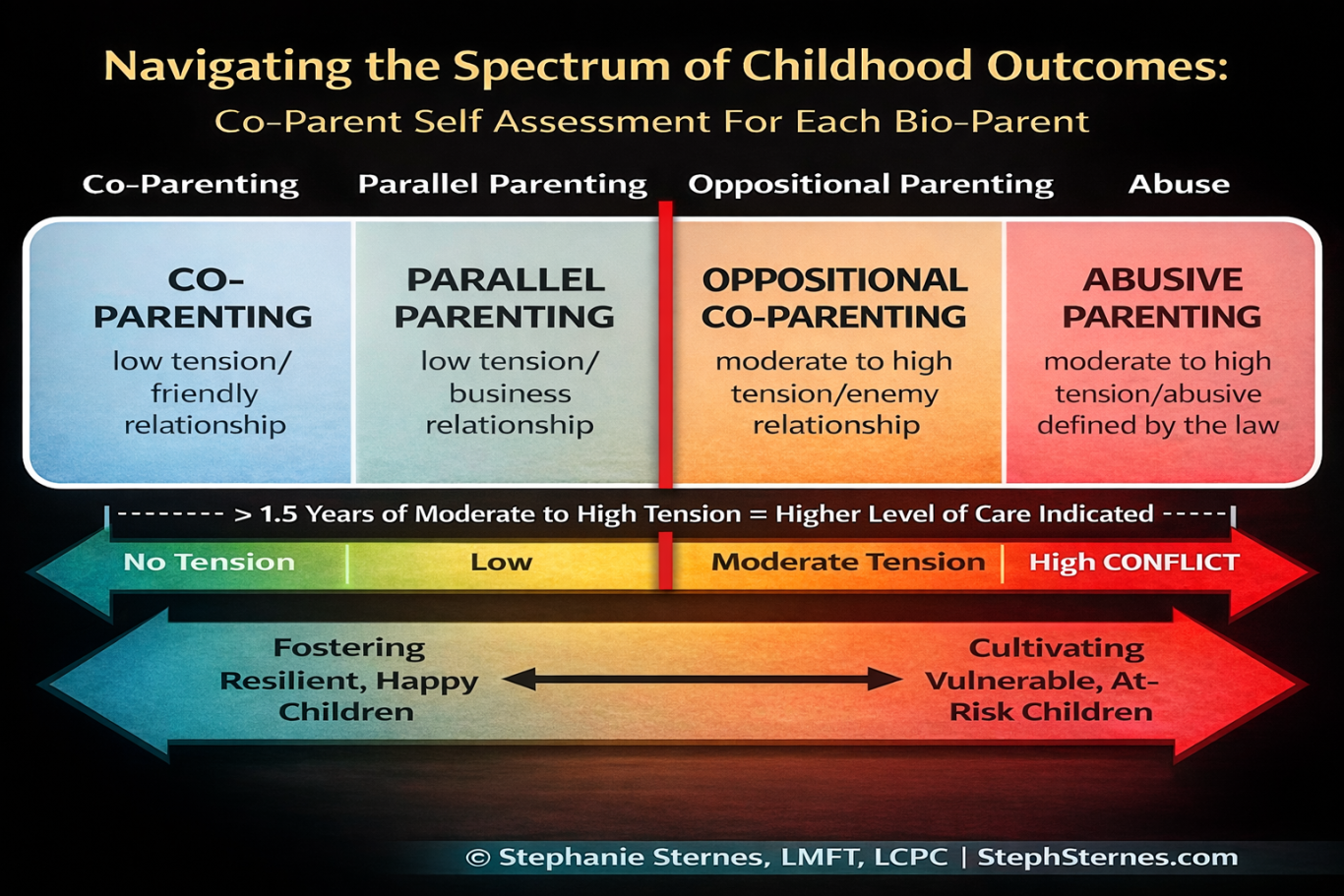
Cooperative Co-Parenting → True Parallel Parenting → Oppositional Co-Parenting → Abuse / Safety Conditions
These are not personality types, diagnoses, or fixed identities. Families may move in either direction. They may function differently around different issues. One parent may be trying to cooperate while the other is operating very differently. A family may also appear relatively functional until a particular issue activates old conflict.
And Abuse / Safety is not simply “very bad co-parenting.” Violence, coercive control, stalking, abuse, dangerous impairment, and serious threats require a safety assessment rather than an assumption that increased cooperation is the goal.
The spectrum helps us recognize when the structure of the relationship between homes has changed.
That distinction matters because the intervention should change with it.
Cooperative Co-Parenting
In cooperative co-parenting, adults can manage enough of the parenting relationship together that the child is largely protected from the adult conflict. They may disagree. They may have very different homes. They may still carry hurt from the relationship that ended.
But they can usually separate those feelings from the work of parenting.
Necessary information moves. Parents can make reasonable adjustments. The child is not routinely used as a messenger. One parent can hear that the child enjoyed the other home without experiencing that enjoyment as a personal rejection. Safe relationships are generally allowed to remain relationships.
Cooperative does not mean conflict-free.
It means the system has enough flexibility to work through ordinary conflict without reorganizing around it.
A cooperative two-home family might still have very different rules. Dad may be stricter about bedtime. Mom may structure homework differently. One home may attend church and the other may not. One parent may value sports while the other prioritizes different activities.
Those differences do not automatically create dysfunction.
Healthy two-home systems do not require sameness. They require enough relational security that difference does not automatically become threat.
True Parallel Parenting
Sometimes cooperation creates more conflict rather than less.
That is where true parallel parenting can be useful.
In parallel parenting, the adult relationship is intentionally narrower. Communication may be limited to necessary information. Responsibilities may be more clearly defined. Parenting plans may need greater specificity. Each parent may manage ordinary day-to-day parenting decisions during their own parenting time without frequent consultation with the other.
AFCC materials recognize cooperative, parallel, and conflicted parenting relationships and the need for parenting arrangements that account for high-conflict circumstances.
I do not see true parallel parenting as failed cooperative parenting.
For some families, it is the healthier structure.
The adults may need distance from one another while the child still needs safe, meaningful relationships with both homes. The goal is to narrow unnecessary adult contact without making the child carry the distance between the adults.
The child should not become the messenger simply because the parents speak less. Medical information still needs to move. School information still needs to move. Transitions still need to function. The child should still be free to talk about the other home, carry appropriate belongings between homes, and maintain safe relationships without being interrogated afterward.
This is a distinction I want professionals to remember:
Low contact is not automatically low conflict.
Two parents can speak very little and still be deeply organized around opposition to one another.
True parallel parenting reduces unnecessary interaction while protecting the child from the conflict.
Oppositional co-parenting does something different.
Oppositional Co-Parenting: When the Other Home Becomes the Reference Point
Oppositional co-parenting begins when parenting decisions increasingly become organized in reaction to the other household rather than primarily around the child.
This does not always begin with hostility.
In fact, it often begins with concern.
One parent believes the other home is too permissive, so this home becomes stricter. The other experiences that increased structure as criticism and becomes more permissive or defensive. One home believes the other communicates too much, so communication is reduced. The other experiences the reduction as exclusion and pursues harder.
A difference has now become a reaction.
Then the reaction gets another reaction.
Over time, the other household becomes the reference point.
“We need more structure because they have none.”
“I let the kids relax because Dad is too controlling.”
“I do not tell her anything because she turns everything into a problem.”
“I have to keep asking because he never tells me anything.”
Eventually, parents may believe they are simply responding to what the other person keeps doing.
Sometimes they are.
But the system is now becoming organized around opposition.
This is the point where I want professionals to look very carefully at sequence, function, safety, and impact rather than assuming both households are contributing equally. Later in this series, False Symmetry and the Reactive Mirror Effect will help us understand why reciprocal reactions do not automatically mean equal causation.
For now, the important distinction is this:
Cooperative parents make decisions alongside one another. Parallel parents make many decisions separately. Oppositional parents increasingly make decisions in response to one another.
That shift matters.
When Safety Changes the Question
There are cases where the language of ordinary co-parenting no longer fits.
If there is family violence, coercive control, stalking, abuse, serious threats, dangerous impairment, or another significant safety concern, the goal should not automatically be better communication, increased flexibility, or more collaboration.
Sometimes a gate needs to close.
Sometimes contact needs greater structure.
Sometimes communication needs to be limited.
Sometimes a professional needs specialized assessment or consultation.
AFCC guidance specifically recognizes the dangers domestic violence can create for parent contact, professional processes, and child exchanges and emphasizes safety-sensitive approaches.
This is why I include Abuse / Safety Conditions in the spectrum while keeping an important distinction: abuse is not simply the far end of “high conflict.”
A person protecting themselves or a child from legitimate danger should not be treated as equally responsible for failing to cooperate.
And at the same time, saying something is about safety does not automatically tell us that every restriction is justified.
We assess.
We do not assume.
That principle will become increasingly important as we move into gatekeeping, False Symmetry, and court-involved systems later in this series.
When Blame Takes Over, Curiosity Usually Leaves
One of the earliest signs that a two-home relationship is moving toward opposition is the amount of attention being given to what is wrong with the other household.
“They never have rules.”
“She babies him.”
“He is too strict.”
“She lets them get away with everything.”
“He doesn't care about school.”
“She controls everything.”
Maybe some of those concerns are true.
The problem begins when proving what is wrong with the other home becomes more important than understanding what the child needs.
Once that happens, parenting choices can start becoming corrective. One household begins trying to provide what it believes the other home lacks. More structure. More freedom. More discipline. More comfort. More accountability. More protection.
The intention may be loving.
But now the child is living in two homes that are increasingly defining themselves against each other.
What one home values, the other corrects.
What one home permits, the other restricts.
What one parent says, the other explains.
The child begins living inside the argument even when no one argues in front of them.
This is why blame is so costly in two-home systems. It narrows our ability to ask the more important systems question:
What is happening between these homes, and what is the child doing to adapt to it?
Children Do Not Live on One Side of the Street
One of the most common pieces of advice given to separated parents is:
“Just keep your side of the street clean.”
I understand why we say it.
Sometimes it is excellent advice. Parents cannot control the other household. Focusing on our own behavior can reduce unnecessary conflict and help people stop trying to manage an ex-partner.
But there is a point where this advice becomes too small for the system.
Children do not live on one side of the street.
They move between homes.
They carry relationships across homes.
They carry school, belongings, family stories, expectations, fears, traditions, and attachment across homes.
Research on divorced families has found meaningful links among interparental conflict, parenting processes, and children’s internalizing and externalizing adjustment. In van Dijk and colleagues’ 2020 meta-analysis, parental support, hostility, structuring, intrusiveness, and role diffusion were among the parenting processes associated with the relationship between interparental conflict and child adjustment.
This does not mean every child problem comes from co-parenting.
It means we should not assume the child’s symptoms exist independently of the family system surrounding them.
If a child is moving between two homes that are increasingly organized against one another, helping only the child adapt may leave the structure producing the strain unchanged.
A Common Clinical Error: Treating the Child While Ignoring the Relationship Between Homes
A child comes to therapy with anxiety.
We teach coping skills.
A child is struggling with transitions.
We work on regulation.
A teenager becomes angry or withdrawn.
We explore thoughts, emotions, relationships, trauma, development, and individual coping.
All of that may be clinically appropriate.
But I want us to ask one more question:
What is happening in the system this child goes home to every week?
Is the child carrying information between adults? Are transitions tense? Are two homes continually correcting one another? Does the child have to change emotional positions depending on which household they are in? Is affection for one relationship harder to express in another? Is the child responsible for keeping the peace?
Individual treatment may be right.
The formulation may still be incomplete.
Seeing the whole system does not mean every clinician must become a family therapist or treat every person connected to the child. It means understanding enough of the relational system to recognize when that system may be shaping the symptoms of the person we are treating.
That is what I mean by Two-Home Family Systems literacy.
What I Want Professionals and Families to Notice
When I look at a two-home family, I am not primarily asking whether the parents get along.
I am asking how the structure functions.
Can necessary information move? Can safe differences exist? Who carries transitions? Who carries conflict? Can children talk freely about each home? Does one parent’s decision automatically trigger a counterdecision in the other? Are adult boundaries protecting the child or making the child responsible for getting around them? Are the adults still responding to the child, or are they increasingly responding to each other?
For families, I want to make this hopeful.
Being in an oppositional pattern does not mean you are a bad parent.
Very loving parents can become reactive when they are frightened, hurt, exhausted, overwhelmed, or convinced that their child needs protection from something happening elsewhere.
What matters is whether we can see the pattern before the pattern becomes the family culture.
The goal is not to make two homes identical.
The goal is not to force former partners into friendship.
The goal is to build enough adult structure that the child can remain a child.
The Co-Parenting Spectrum Principle
The Sternes Co-Parenting Spectrum is an applied Two-Home Systems framework for understanding how the relationship between parenting households may function across Cooperative Co-Parenting, True Parallel Parenting, Oppositional Co-Parenting, and Abuse / Safety Conditions.
The spectrum is not a diagnosis, validated assessment instrument, custody standard, or claim that families inevitably progress through these positions in a fixed order. It is an organizing framework intended to help professionals identify what kind of relationship exists between homes and whether the current intervention matches the system in front of them.
At the center of the framework is a simple idea:
The less effectively adults carry the relationship between homes, the more likely someone else in the system will begin carrying the strain. Very often, that someone is the child.
That is why understanding the co-parenting relationship comes first.
Research Note: Why I Use 18 Months
The 18-month marker is a practice-informed clinical checkpoint, not a validated cutoff. Research consistently links persistent interparental conflict with poorer child adjustment, and many children show substantial adjustment within about two years after separation.
I use 18 months as an earlier point to ask whether the conflict is becoming entrenched and whether the family needs a different or higher level of care rather than waiting longer.
References
O’Hara, K. L., & Cohen, B. R. (2024). Family Court Review, 62(1), 160–175. https://doi.org/10.1111/fcre.12771
van Dijk, R., van der Valk, I. E., Deković, M., & Branje, S. (2020). Clinical Psychology Review, 79, 101861. https://doi.org/10.1016/j.cpr.2020.101861
Bridge to Article 2
The next question is what happens when the relationship between homes begins organizing itself around opposition.
What starts as difference can become reaction. What begins as concern can become rigidity. What begins as protection can become a pattern in which each household increasingly defines itself against the other.
The adults may still believe they are parenting the child.
But more and more of their parenting decisions are being shaped by the other home.
That is Oppositional Co-Parenting: The Enemy Relationship.
Article 2: Oppositional Co-Parenting
When the Relationship Between Homes Becomes Organized Around the Enemy
Citation Note
The Sternes Co-Parenting Spectrum and Oppositional Co-Parenting are applied Two-Home Clinical Frameworks developed by Stephanie Sternes, LMFT, LCPC, NCC, through clinical practice, counselor education, professional training, consultation, and work with two-home and stepfamily systems.
The frameworks build upon established research in coparenting, divorce, family systems, stepfamily development, child adjustment, and high-conflict family processes. Established concepts and research remain credited to their respective originators.
The Sternes Co-Parenting Spectrum is an educational and clinical organizing framework. It is not a diagnosis, forensic finding, custody recommendation, or validated assessment instrument.
References
Association of Family and Conciliation Courts. (2019). Guidelines for parenting coordination. Association of Family and Conciliation Courts. AFCC materials recognize cooperative, parallel, and conflicted parenting relationships and address parenting arrangements and safety considerations in high-conflict cases.
Feinberg, M. E. (2003). The internal structure and ecological context of coparenting: A framework for research and intervention. Parenting: Science and Practice, 3(2), 95–131. https://doi.org/10.1207/S15327922PAR0302_01
Feinberg, M. E., Kan, M. L., & Hetherington, E. M. (2007). The longitudinal influence of coparenting conflict on parental negativity and adolescent maladjustment. Journal of Marriage and Family, 69(3), 687–702. https://doi.org/10.1111/j.1741-3737.2007.00400.x
Kelly, J. B., & Emery, R. E. (2003). Children’s adjustment following divorce: Risk and resilience perspectives. Family Relations, 52(4), 352–362.
Papernow, P. L. (2013). Surviving and thriving in stepfamily relationships: What works and what doesn’t. Routledge.
Papernow, P. L. (2018). Clinical guidelines for working with stepfamilies: What family, couple, individual, and child therapists need to know. Family Process, 57(1), 25–51.
van Dijk, R., van der Valk, I. E., Deković, M., & Branje, S. (2020). A meta-analysis on interparental conflict, parenting, and child adjustment in divorced families: Examining mediation using meta-analytic structural equation models. Clinical Psychology Review, 79, 101861. https://doi.org/10.1016/j.cpr.2020.101861
ARTICLE 2
Oppositional Co-Parenting: The Enemy Relationship
When Parenting Becomes Organized Around the Other Home Instead of the Child
In Article 1, I introduced the Sternes Co-Parenting Spectrum: Cooperative Co-Parenting, True Parallel Parenting, Oppositional Co-Parenting, and Abuse / Safety Conditions. The purpose of that spectrum is not to label parents. It is to help us recognize when the relationship between two homes has changed enough that the intervention needs to change too.
Oppositional co-parenting is the point on that spectrum where I begin to see something different happening. The parents are no longer simply parenting differently, and they are not simply using distance to contain conflict. The other household has begun to become an organizing force in parenting decisions.
The question is no longer only, “What does my child need?”
Increasingly, another question is operating underneath it:
“What is the other home doing, and what do I need to do in response?”
That is what I mean by Oppositional Co-Parenting: The Enemy Relationship.
The other home becomes something to manage, defend against, correct, expose, contain, or defeat.
The parents may still love their child deeply. They may genuinely believe they are protecting the child. But over time, the relationship between the homes can begin organizing more and more of the family system.
Difference Is Not the Problem
Two homes are going to be different.
One parent may be more structured. The other may be more relaxed. One may prioritize academics, while the other values sports or outdoor time. One home may have more financial resources. One may be religious and the other may not be. Bedtimes, food, chores, activities, discipline, screen time, and expectations may all differ.
Children can usually learn to live with difference.
We already ask children to do this everywhere else. School has different rules than home. Grandma’s house has different expectations. Coaches and teachers have different styles. Children learn that relationships and environments are not identical.
The problem is not simply that two homes are different.
The problem begins when difference becomes evidence.
“See? They have no rules.”
“See? He is controlling.”
“See? She lets them do whatever they want.”
“See? They do not care about school.”
Now the other household is no longer simply different. It is wrong.
And once one home becomes wrong, the current home often begins organizing itself in opposition to it.
When Parenting Becomes a Reaction
This can happen gradually.
One parent believes the other home is too permissive, so they become stricter. The other household experiences that increased structure as controlling and becomes more flexible. The first parent sees the added flexibility and becomes even more convinced that stronger rules are necessary.
One parent believes the other asks too many questions, so they share less information. The other experiences the reduced information as exclusion and begins asking more. The increased pursuit confirms the first parent’s belief that communication needs to be restricted.
One home becomes increasingly concerned about what happens in the other, so the child is questioned after transitions. The child becomes uncomfortable and gives shorter answers. The shortened answers create more suspicion, which leads to more questions.
At some point, the families are not simply responding to the child anymore.
They are responding to each other.
This is why I call it an enemy relationship. It does not mean the parents literally hate each other. It means the other household increasingly becomes the reference point against which decisions, beliefs, boundaries, and even identity are organized.
The family begins living in response to an opponent.
Parallel Parenting and Oppositional Parenting Are Not the Same Thing
This distinction is especially important because low communication can look similar from the outside.
True parallel parents may have very little contact. They may use a parenting application, communicate only necessary information, follow a detailed schedule, and make most routine decisions independently.
That can be healthy.
The distance serves a purpose: reduce adult conflict while preserving the child’s safe relationships.
Oppositional parents may also communicate very little, but the emotional organization is different. They may still monitor one another closely, interpret ordinary choices through the history of the conflict, react to what happens in the other household, use schedules or information as leverage, and remain highly emotionally organized around the former partner.
The parents may barely speak and still occupy a tremendous amount of space in each other’s lives.
That is why:
Low contact is not automatically low conflict.
True parallel parenting creates enough distance that the adults can stop reacting to each other.
Oppositional co-parenting may create distance while the conflict continues traveling through the child, the schedule, the school, the new spouse, the therapist, the attorney, or the court.
The adults are separate.
The system is not.
The Enemy Relationship Can Recruit the Whole Family
Once opposition becomes established, it rarely stays between two former partners.
New spouses get pulled in. Grandparents take positions. Siblings hear different stories. Teachers receive competing explanations. Therapists become part of the communication system. Attorneys and courts may eventually become the only place the adults believe the conflict can be resolved.
This is particularly important in stepfamilies. Papernow’s work reminds us that stepfamilies already have more complicated structural and developmental tasks than first-time families. There are pre-existing parent-child attachments, insider and outsider positions, losses, stepparent role development, and another parent or household that remains part of the child’s family system.
When the co-parenting relationship is oppositional, the stepfamily has to develop while also carrying conflict from another household.
A new spouse may become protective of their partner. That is understandable. But eventually the stepparent may find themselves arguing with, defending against, monitoring, or trying to manage a former partner they never chose to have in their relationship.
The new marriage begins spending energy on the old relationship.
The conflict has found another carrier.
The Child Is Often the Easiest Path Between Homes
Adults can block each other.
Children usually cannot.
The child goes back and forth.
That makes the child the easiest pathway through the system.
The child can become the messenger: “Tell your mom…”
The information source: “What happened at Dad’s?”
The witness: “Did you see who was there?”
The evidence: “Even she says she doesn’t want to go.”
The peacekeeper: “Don’t tell Mom because she’ll get upset.”
The emotional caretaker: “Dad gets so sad when you leave.”
The judge: “Where do you want to live?”
Often none of this starts with an adult saying, “I want my child in the middle.”
Parents may sincerely believe they are gathering information, validating feelings, protecting the child, or responding to something the other household has done.
But children learn quickly.
They learn what each home wants to know.
They learn what creates tension.
They learn which answers bring relief.
They learn when honesty creates another argument.
Soon the child may begin managing the information without being asked.
That is when the adult conflict starts becoming part of the child’s internal world.
When Concern Becomes Organization
One of the hardest things about oppositional systems is that they often grow from legitimate concerns.
A parent may really be inconsistent.
A parent may have made poor decisions.
A stepparent may genuinely be overstepping.
Communication may truly be terrible.
There may have been betrayal, abandonment, court conflict, financial disputes, or years of hurt.
The existence of a real concern does not mean every response to that concern remains healthy forever.
This is where I want us to distinguish having a concern from organizing the family around the concern.
If every new event is interpreted through the same conclusion about the other parent, if every difference becomes evidence, if the child is continually asked to help determine what happened, and if the current household increasingly defines itself as the opposite of the other, the concern may have become something larger.
The enemy relationship has become part of the family structure.
This does not mean the concern was imaginary.
It means we also need to understand what the response to that concern is now doing.
Oppositional Does Not Mean Equal
I want to make this clear early in the series because it will become very important later.
Calling a relationship Oppositional Co-Parenting does not mean I am saying both parents caused it equally.
One parent may be far more oppositional than the other.
One may repeatedly provoke while the other reacts.
One may restrict while the other pursues.
One may consistently support the child’s relationship with the other parent while receiving very little of that support in return.
Sometimes both adults are deeply engaged in the enemy relationship.
Sometimes one is trying to move toward parallel parenting and the other continues trying to pull the system back into conflict.
Sometimes a behavior that looks oppositional is actually protective because there is a legitimate safety concern.
We cannot know simply by looking at the fact that conflict exists.
That is why later in this series I introduce False Symmetry.
For now, the principle is simple:
Two adults can be caught in the same system without contributing the same thing to it.
A systems formulation should make us more precise, not less.
Why “Just Communicate Better” Often Fails
When professionals see co-parenting conflict, one of the most natural interventions is to encourage better communication.
Sometimes that is exactly what is needed.
But in an oppositional system, more communication can simply create more opportunity for opposition.
If every text becomes evidence, more texting does not solve the problem.
If every conversation becomes a debate about the past, another conversation may not help.
If one parent experiences flexibility as losing and the other experiences structure as control, telling them to “compromise” may create another battleground.
Sometimes the first intervention is not more communication.
It is less reactivity.
Clearer boundaries.
More specific information.
Fewer opportunities for adult conflict.
A better understanding of what truly needs to move between homes and what does not.
And sometimes the adults need true parallel parenting before anything more cooperative is realistic.
The intervention has to match the system.
A Common Clinical Error: Treating Two Separate Parents Instead of One Connected System
A therapist may see Mom.
Another clinician sees Dad.
The child has a counselor.
The stepcouple sees someone else.
Everyone may be doing good work.
But no one may be looking at the relationship between the systems.
Mom learns boundaries.
Dad learns regulation.
The child learns coping skills.
The stepcouple works on communication.
Then everyone goes home and re-enters the same oppositional structure.
The problem is not that individual therapy is wrong.
It may be very important.
The problem is assuming that treating individuals automatically changes the relational system connecting them.
The first formulation may be reasonable and still be incomplete.
This is one of the reasons I believe professionals need Two-Home Family Systems literacy even when they are not family therapists and even when they are treating only one person.
Seeing the system does not require treating everyone.
It requires understanding enough of the system to know what may be affecting the person you are serving.
When Opposition Reaches the Child’s Relationships
Eventually, something more serious can happen.
The child begins to understand that the conflict is not only between the adults.
It involves relationships the child cares about.
Mom’s feelings about Dad.
Dad’s feelings about Mom.
A biological parent’s feelings about a stepparent.
A household’s feelings about grandparents.
One family’s interpretation of the other.
The child begins noticing that relationships are not emotionally neutral territory.
Enjoying one relationship can affect another.
Talking about one home can change the mood in the other.
Liking a stepparent may feel complicated.
Missing a parent may feel disloyal.
Now the issue is no longer only oppositional co-parenting.
The opposition is beginning to affect belonging.
And that is where Article 3 begins.
What I Want Professionals and Families to Notice
When I think a family may be moving toward oppositional co-parenting, I start watching where the attention goes. How much of each household’s parenting is organized around what the other home is doing? Are ordinary differences becoming evidence? Is the child being asked to carry information? Are parents reacting to the child, or reacting to each other through the child? Do schedules, school, activities, clothing, medical decisions, or communication repeatedly become symbols of the larger conflict?
I also want to know whether the family can still tolerate anything that does not fit its story about the other household. Can Mom acknowledge something Dad does well? Can Dad recognize a legitimate concern from Mom? Can either home change without the other assuming there must be another motive?
When the answer is consistently no, the enemy relationship may be getting stronger.
For families, I want to say this carefully: You do not have to trust someone who has repeatedly proven unreliable. You do not have to ignore legitimate problems. You do not have to make unsafe relationships more accessible in order to appear cooperative.
But there is a difference between responding to a problem and building a family identity around opposition to the person you believe created it.
Your child lives in more than one relationship.
Protecting your child includes protecting their freedom to experience those relationships as directly as safety allows.
The Oppositional Co-Parenting Principle
Oppositional Co-Parenting: The Enemy Relationship is a Sternes Two-Home Clinical Framework describing a relational organization in which parenting decisions, interpretations, boundaries, and reactions become increasingly structured in opposition to the other household.
The framework does not mean that both parents contribute equally, that conflict itself proves opposition, or that appropriate safety boundaries are oppositional. It asks professionals to notice when the other household has become a central reference point around which the current household organizes its parenting.
The key question is:
Are these adults primarily responding to what the child needs—or increasingly responding to what the other home represents?
That difference matters because once the other household becomes the enemy, children may begin experiencing their own relationships differently.
And that brings us to the next article.
Bridge to Article 3
Children are attached to people in both systems.
What happens when the adults’ opposition begins making those attachments feel incompatible?
What happens when a child realizes that enjoying one relationship may hurt another person?
What happens when disagreement creates relational risk?
And what happens when the child begins believing that belonging requires allegiance?
That is the Love–Loyalty Paradox.
Article 3: The Love–Loyalty Paradox
When Belonging Becomes Linked to Allegiance in Two-Home Family Systems
Citation Note
Oppositional Co-Parenting: The Enemy Relationship is an applied Sternes Two-Home Clinical Framework developed by Stephanie Sternes, LMFT, LCPC, NCC, through clinical practice, counselor education, professional training, consultation, and work with two-home and stepfamily systems.
The framework builds upon established research in coparenting, interparental conflict, family systems, stepfamily development, parent-child relationships, and child adjustment. It does not replace established concepts such as coparenting conflict, parallel parenting, triangulation, gatekeeping, or family violence.
Oppositional Co-Parenting is an educational and clinical organizing framework. It is not a diagnosis, forensic finding, custody standard, validated assessment instrument, or presumption of equal parental contribution.
References
Bowen, M. (1978). Family therapy in clinical practice. Jason Aronson.
Feinberg, M. E. (2003). The internal structure and ecological context of coparenting: A framework for research and intervention. Parenting: Science and Practice, 3(2), 95–131. https://doi.org/10.1207/S15327922PAR0302_01
Feinberg, M. E., Kan, M. L., & Hetherington, E. M. (2007). The longitudinal influence of coparenting conflict on parental negativity and adolescent maladjustment. Journal of Marriage and Family, 69(3), 687–702. https://doi.org/10.1111/j.1741-3737.2007.00400.x
Johnston, J. R. (1994). High-conflict divorce. The Future of Children, 4(1), 165–182.
Kelly, J. B., & Emery, R. E. (2003). Children’s adjustment following divorce: Risk and resilience perspectives. Family Relations, 52(4), 352–362.
Minuchin, S. (1974). Families and family therapy. Harvard University Press.
Papernow, P. L. (2013). Surviving and thriving in stepfamily relationships: What works and what doesn’t. Routledge.
Papernow, P. L. (2018). Clinical guidelines for working with stepfamilies: What family, couple, individual, and child therapists need to know. Family Process, 57(1), 25–51.
van Dijk, R., van der Valk, I. E., Deković, M., & Branje, S. (2020). A meta-analysis on interparental conflict, parenting, and child adjustment in divorced families: Examining mediation using meta-analytic structural equation models. Clinical Psychology Review, 79, 101861. https://doi.org/10.1016/j.cpr.2020.101861

Article 3
When Loyalty Replaces Love:
The Love-Loyalty Paradox in Co-Parenting
The Most Dangerous Form of Oppositional Co-Parenting
When Belonging Becomes Linked to Allegiance in Two-Home Family Systems
In Article 2, we introduced Oppositional Co-Parenting: The Enemy Relationship—a pattern in which the relationship between two homes becomes increasingly organized around opposition. But opposition alone does not explain why some children become caught so deeply in the conflict between households.
To understand that, we have to look at something more personal. What happens when a child begins to believe that loving one person may hurt another? What happens when enjoying one home feels disloyal to the other? What happens when belonging begins to require alignment?
This is the territory of the Love–Loyalty Paradox.
The Breakfast Table
No one is yelling. The table is set. The routine is familiar. The adults are doing what they believe is right.
A child sits quietly, choosing words carefully. She laughs a little less and watches faces before answering. She knows which stories from the other home are easy to tell and which ones are better left unsaid.
She says she had fun with Dad. There is a pause, a look, maybe a question. Nothing dramatic happens. No one says, “You are not allowed to love your dad.”
But the child notices. And next time, she says a little less.
Some parts of me may feel safer to show here than others.
This is one way the Love–Loyalty Paradox can begin.
Naming the Pattern
The Love–Loyalty Paradox is a Sternes Two-Home Clinical Framework describing a relational dilemma that may occur when a child experiences connection with one important person or household as carrying a cost in another important relationship.
The child may begin asking, consciously or unconsciously:
Can I love them and still belong with you?
Loyalty itself is not bad. Children naturally feel loyalty toward parents, siblings, grandparents, stepparents, and the people who care for them. Family identity matters. Attachment matters. Belonging matters.
The concern begins when belonging starts to depend on allegiance. Agreement may begin to feel safer than difference. Alignment may feel safer than neutrality. Protecting an adult may feel safer than telling the truth about the child’s own experience.
The child is no longer simply learning to live in two homes. The child may be trying to protect two attachments that feel as though they cannot safely exist at the same time.
Love and Loyalty Are Not the Same Thing
Love has room.
Three Ways Belonging May Be Organized Across Two Homes
As I have continued developing the Love-Loyalty Paradox, I have found it helpful to think about three possible configurations: Love-Love, Love-Loyalty, and Loyalty-Loyalty. These are not diagnoses or fixed family types. They are practice-informed ways of asking what the child may be learning about love, loyalty, and belonging across the two homes.
Love-Love
In a Love-Love configuration, both homes give the child room to maintain safe relationships across the family system. The adults may disagree, dislike one another, or parent very differently, but the child does not have to reduce one relationship in order to protect another.
The child can miss Mom while staying with Dad. They can enjoy Dad’s home without reassuring Mom that they still love her. They can care about a stepparent without that relationship being experienced as a replacement. They can be angry with one parent without being recruited into an alliance with the other.
Love remains large enough to hold difference.
The child’s relationships do not have to compete for belonging.
Love-Loyalty
A Love-Loyalty configuration may look very different because the two homes are operating by different relational rules.
One home may communicate, directly or indirectly, “You are free to love the people who matter to you.” The other may experience the child’s independent relationship, affection, enjoyment, or disagreement as disloyalty.
This can create an especially confusing position for the child. The child may move from a home where love is expansive into a home where belonging feels more dependent on allegiance.
The child may begin monitoring what can safely travel between the homes. A good experience becomes shortened. Affection becomes hidden. A relationship may be defended in one home and minimized in the other.
The child is not necessarily choosing one parent over another.
The child may be trying to stay connected to two homes that are asking for very different things.
Loyalty-Loyalty
In a Loyalty-Loyalty configuration, both homes may increasingly organize belonging around allegiance.
Each household may feel that supporting the child means protecting the child from the other home, correcting the other home’s story, or ensuring that the child understands who is right. Both may feel injured, misunderstood, or threatened by the child’s closeness with the other household.
Now the child may feel pressure from both directions.
Enjoying Mom may hurt Dad. Enjoying Dad may hurt Mom. Loving a stepparent may feel dangerous in the other home. Telling the truth about one relationship may create consequences in another.
The child may become increasingly careful, divided, protective, or aligned because there is no relationally neutral place to stand.
This may be the most difficult configuration for the child because the question is no longer simply, “Can I love them and still belong with you?”
It may become:
“Where can I safely belong if loving anyone feels like choosing against someone else?”
These configurations are not intended to tell us which parent is good or bad. They invite a different question:
What does each home require from the child in order for the child to experience belonging there?
That question may tell us much more about the child’s relational world than simply asking which parent the child appears closest to.
How This Fits With Family-Systems Theory
This distinction matters to me because the Love–Loyalty Paradox is not another name for enmeshment, triangulation, fusion, or poor differentiation.
Those concepts already exist, and they matter.
Bowen family systems theory helps us understand differentiation of self, emotional interdependence, relational anxiety, and triangles. It gives us language for what happens when people have difficulty holding onto their own thoughts, feelings, and position while remaining connected to important relationships.
Minuchin’s structural family therapy gives us another important map. It helps professionals recognize family structure, boundaries, subsystems, hierarchy, coalitions, disengagement, and enmeshment.
Those theories help us identify what the relational pattern looks like.
The Love–Loyalty Paradox asks another question:
Why might differentiation become emotionally dangerous for this child in this particular two-home system?
That is where I see the distinction.
Enmeshment Describes the Pattern. Love–Loyalty Asks What May Be Organizing It.
In an enmeshed relationship, boundaries can become overly diffuse. There may be too little room for independent thoughts, feelings, relationships, or developmental autonomy. A child may become unusually responsible for a parent’s emotional state. A parent may have difficulty tolerating the child’s independence. The child may begin organizing behavior around keeping the adult emotionally stable.
Those are established family-systems patterns. The Love–Loyalty Paradox does not rename them.
What it asks is whether, in some two-home systems, belonging pressure may be making differentiation more difficult.
The child is not only asking, “Can I have my own opinion?”
The child may also be asking:
Can I have my own opinion and still keep my relationship with you?
Or:
Can I love them and still belong here?
When the answer feels uncertain, alignment can begin to feel safer than differentiation.
The child may move closer to one parent, protect that parent emotionally, hide affection for another person, stop talking about one home in the other, or reject a relationship that feels too costly to maintain openly.
This does not mean the Love–Loyalty Paradox causes every enmeshed relationship. It does not. Enmeshment can develop for many reasons, and loyalty conflicts can exist without enmeshment.
The Love–Loyalty Paradox offers a more specific hypothesis for some two-home systems:
When a child experiences connection with one relationship as threatening belonging in another, alignment may begin to feel safer than independence.
That is something worth assessing.
What Is the Child Required to Do to Belong?
This may be the most important question in the framework:
What is this child required to do relationally in order to feel that they still belong?
Do they have to agree? Protect? Hide? Choose? Keep secrets? Minimize affection? Monitor someone’s mood? Become responsible for an adult’s hurt?
The child may not consciously understand any of this.
Children are exceptionally good at reading relationships. They notice what brings closeness. They notice what creates distance. They notice what makes adults tense and what makes adults relax.
And they adapt.
That adaptation may look like maturity, preference, defiance, anxiety, rejection, or even calmness. But before we decide what the behavior means, we need to understand the relational system around it.
From Belonging Pressure to a Larger System Pattern
Once we widen the lens, behavior that looked confusing can begin to make more sense.
A child becomes increasingly aligned with one household. The other parent experiences the distance as rejection and begins pushing harder for contact. The child feels more pressure and withdraws further. The first parent sees the withdrawal and becomes even more convinced that contact with the other parent is harmful.
More restrictions follow.
The other parent reacts.
The child reacts to the reaction.
Now everyone has evidence supporting what they already believed.
The cycle grows.
That does not tell us who started it. It does not tell us who is right. It tells us that we are no longer looking at one person’s behavior.
We are looking at a relational system.
The question changes from:
“What is wrong with this child?”
to:
What is happening around this child that makes this response make sense?
The Bridge to Gatekeeping
This is also where parental gatekeeping becomes important.
Gatekeeping is an established concept in separation, divorce, and family-court literature. It describes parental attitudes and behaviors that may facilitate, restrict, or protect another parent’s involvement or relationship with the child.
Gatekeeping and the Love–Loyalty Paradox are not the same thing. They describe different parts of the system.
Gatekeeping describes what an adult may be doing around a relationship. The Love–Loyalty Paradox describes what that relational environment may begin to mean inside the child.
A parent may restrict contact. A parent may withhold information. A child may learn that talking about the other household creates tension. A child may notice that affection for one parent hurts the other.
Over time, the gate can become emotional as well as practical.
But we cannot automatically assume that a closed gate is unhealthy. Sometimes a gate needs to close because there is real danger. Family violence, abuse, coercive control, dangerous impairment, stalking, serious threats, or other credible risks require protection.
That is why we assess.
We do not assume.
The question is not simply, “Is someone gatekeeping?” We ask what gate is being controlled, why it is being controlled, whether the restriction fits the concern, what happens to the child, and what happens throughout the rest of the family system when that gate opens or closes.
We will look much more closely at this in Article 5: Gatekeeping in Two-Home Family Systems.
Why This Matters
Divorce itself does not explain a child’s outcome. The relational environment surrounding the child matters.
Conflict matters. Parenting matters. Attachment matters. Emotional security matters. The relationship between the homes matters.
And these factors interact.
The Love–Loyalty Paradox is not presented as a proven explanation for every anxious child, every resistant child, or every child who becomes highly aligned with one parent.
It gives us another question to ask:
Is this child experiencing love and belonging as compatible—or as competing demands?
Sometimes silence reduces tension. Sometimes avoidance brings relief. Sometimes alignment preserves connection. Sometimes refusal may protect a child from a relational conflict they do not know how to resolve.
And sometimes a child truly has an independent and well-founded reason for wanting distance from a parent.
We need enough humility to hold all of those possibilities while we assess.
When I Start Looking More Closely
There are patterns that make me want to widen the lens.
A child watches an adult’s face before talking about the other home. A child minimizes a good experience or seems guilty after enjoying the other parent. A child becomes unusually responsible for protecting an adult from hurt. Affection for a stepparent begins to feel disloyal.
Sometimes the child gives very different accounts depending on which household is present. A sweatshirt, photograph, birthday gift, or ordinary family tradition becomes a symbol of allegiance. The child begins using adult conflict language that seems far beyond their developmental level. The child appears safest when agreeing.
One relationship increasingly seems to require rejection of another.
None of these things proves the Love–Loyalty Paradox.
They tell me to get curious.
A Common Clinical Error: Treating the Symptom Without Understanding the System
A child may arrive in counseling with anxiety, depression, anger, school refusal, transition problems, behavior concerns, or refusal to see a parent.
Individual treatment may be exactly what that child needs. Medication may sometimes be appropriate. Coping skills may help. Trauma work may help. Attachment work may help.
But the first formulation can be reasonable and still be incomplete.
If the child returns each week to a relational system in which loving one person threatens another relationship, we have to understand that environment too.
Otherwise, we risk teaching the child to become better at tolerating something adults have not yet addressed.
Seeing the whole system does not mean treating everyone in the system. It means understanding enough of the system to know what may be shaping the person we are treating.
That is the shift from an individual-only lens to Two-Home Family Systems literacy.
Why Naming the Love–Loyalty Paradox Matters
Without language for belonging pressure, we can easily focus only on what the child is doing.
Anxious. Avoidant. Oppositional. Angry. Compliant. Resistant. Refusing. Aligned.
But I want us to ask one more question:
What relationship might this behavior be helping the child preserve?
That question changes things.
Naming the Love–Loyalty Paradox does not establish blame. It does not determine which parent is right. It does not prove that a child has been manipulated. It does not eliminate the possibility that a parent has genuinely harmed the child.
It tells us where to look next.
For Clinicians and Other Helping Professionals
When a child is not improving despite good individual work, widen the lens.
What is happening inside the child? What is happening between the important relationships? What developmental realities are present in the stepfamily? What is happening inside each household? What is happening between the homes?
Can this child freely express love, anger, disappointment, happiness, connection, and belonging across safe relationships?
A diagnosis may tell us something important about what the child is experiencing. It may not tell us everything about why that experience keeps being activated.
And counselors are not the only professionals who encounter these systems. Coaches, clergy, educators, school counselors, parent coordinators, mediators, attorneys, court-facing professionals, foster and adoption professionals, and others may all encounter families whose relationships stretch across multiple homes.
We do not all have the same role. We should not all be doing the same assessment or intervention.
But we can all learn to see more of the system.
For Families
Children should not have to prove love by limiting love.
Your child can love you and their other parent. They can love a stepparent without replacing you. They can have fun somewhere else without loving you less. They can miss the other home while sitting in yours. They can be angry with you and still belong with you.
They can have their own experience.
That is not disloyalty.
That is development.
Children need enough relational safety to love without taking sides.
A child’s family story may contain parents, stepparents, siblings, stepsiblings, grandparents, foster relationships, adoptive relationships, and other people who matter deeply to them.
A child’s heart does not need to operate like a custody schedule.
For Courts and Court-Facing Professionals
Children’s voices matter.
But their words also have context.
A child saying, “I do not want to go,” tells us something important. It does not tell us everything.
We still need to understand what is happening in the relationships around the child. What happens when the child talks about each parent? What happens when they show affection? What relational gates are open? Which ones are closed? Why?
Is the child being given an appropriate developmental voice, or has the child been handed responsibility for an adult decision? Are there legitimate safety concerns? Is the child adapting to conflict? Are adult behaviors reinforcing the alignment? What other explanations remain possible?
The purpose is not to ignore the child.
The purpose is to understand the child more fully.
The Core Distinction
Bowen and Minuchin help us recognize established patterns in family systems.
The Love–Loyalty Paradox asks what may make independent attachment or differentiation feel relationally dangerous in some two-home systems.
Gatekeeping helps us recognize adult behaviors that may facilitate, narrow, protect, or restrict relational pathways.
The Two-Home Systems lens asks how all of those pieces interact across multiple connected households.
That moves us beyond one question:
What is wrong with this child or parent?
and toward a bigger one:
What is happening in the relational system surrounding them?
That is where this work begins.
Citation Note
The Love–Loyalty Paradox is an applied Sternes Two-Home Clinical Framework developed by Stephanie Sternes, LMFT, LCPC, NCC, through clinical practice, counselor education, professional training, consultation, and work with two-home and stepfamily systems.
The framework does not replace established theories of attachment, family systems, differentiation, triangulation, structural family therapy, enmeshment, stepfamily development, parental gatekeeping, or parent-child contact problems.
It offers an original organizing hypothesis focused on the relationship between attachment, belonging, allegiance, and relational freedom across homes.
Established theories and research remain credited to their respective originators.
References
Association of Family and Conciliation Courts, & National Council of Juvenile and Family Court Judges. (2022). AFCC and NCJFCJ joint statement on parent-child contact problems.
Austin, W. G., Pruett, M. K., Kirkpatrick, H. D., Flens, J. R., & Gould, J. W. (2013). Parental gatekeeping and child custody/child access evaluation: Part I: Conceptual framework, research, and application. Family Court Review, 51(3), 485–501. https://doi.org/10.1111/fcre.12045
Bowen, M. (1978). Family therapy in clinical practice. Jason Aronson.
Boszormenyi-Nagy, I., & Spark, G. M. (1973). Invisible loyalties: Reciprocity in intergenerational family therapy. Harper & Row.
Cummings, E. M., & Davies, P. T. (2010). Marital conflict and children: An emotional security perspective. Guilford Press.
Kelly, J. B., & Emery, R. E. (2003). Children’s adjustment following divorce: Risk and resilience perspectives. Family Relations, 52(4), 352–362.
Minuchin, S. (1974). Families and family therapy. Harvard University Press.
Papernow, P. L. (2013). Surviving and thriving in stepfamily relationships: What works and what doesn’t. Routledge.
Saini, M. A., Drozd, L. M., & Olesen, N. W. (2017). Adaptive and maladaptive gatekeeping behaviors and attitudes: Implications for child outcomes after separation and divorce. Family Court Review, 55(2), 260–272. https://doi.org/10.1111/fcre.12276
Sternes, S. (2026). The Love–Loyalty Paradox [Two-Home Clinical Framework].
van Dijk, R., van der Valk, I. E., Deković, M., & Branje, S. (2020). A meta-analysis on interparental conflict, parenting, and child adjustment in divorced families: Examining mediation using meta-analytic structural equation models. Clinical Psychology Review, 79, 101861. https://doi.org/10.1016/j.cpr.2020.101861

ARTICLE 4
The Co-Parenting Relationship: The Load-Bearing Structure of Two-Home Families
When the Co-Parenting Relationship Carries the System, Children Don’t Have To
The Co-Parenting Relationship Is Not the Former Couple Relationship
This distinction matters. The romantic relationship may be over. The marriage may be over. The adults may want very little to do with one another personally, and they may eventually remarry and build entirely new family systems. But if they are still parenting the same child, their parenting systems remain connected.
The former couple relationship may end, but the parenting relationship does not. That does not mean the parents need emotional closeness. It means there is still information, responsibility, decision-making, transition, and relationship moving between the homes. The important question is whether the adults carry that connection or whether the child gradually becomes responsible for carrying it for them.
I think this is one of the places we make co-parenting harder than it needs to be. When people hear the word co-parenting, they often picture former partners talking easily, attending events together, being flexible, solving problems collaboratively, and maybe even becoming friends. That is one version of co-parenting, but it is not the only healthy version.
Functional co-parenting does not require friendship, emotional intimacy, forgiveness on demand, identical parenting practices, or constant communication. Sometimes the healthiest relationship between homes is highly structured. Sometimes it is low contact. Sometimes true parallel parenting is exactly what the family needs. In families involving coercive control, family violence, stalking, abuse, serious threats, or dangerous power imbalances, increased communication may actually make things worse.
The goal is not closeness. The goal is functionality, predictability, boundaries, and adult responsibility. Can the adults carry what belongs to the adults without asking the child to carry it for them?
What Does the Co-Parenting Relationship Actually Carry?
Think about a bridge. A bridge does not make the two sides the same, and it does not erase the distance between them. Its job is to carry necessary weight safely from one side to the other. The co-parenting relationship works in much the same way.
It carries school information, medical information, schedules, activities, medications, transportation, changes in plans, and developmental concerns. It helps organize transitions and keeps children from becoming the communication system between adults. But it also carries something harder to see: relational permission.
A healthy adult structure gives a child permission to love, miss, enjoy, speak openly, and belong. A child should be able to say, “I had fun with Dad,” “I miss Mom,” or “I really like my stepmom” without first checking the emotional temperature of the room. The adults may have strong feelings about one another, but those feelings should not become the child’s responsibility to manage.
A functioning co-parenting structure tells the child:
The adults will manage the adult relationship. You do not have to manage it for us.
Two Homes Do Not Need to Become One Home
Another mistake I see is confusing coordination with sameness. Two homes do not need to operate the same way. They may have different bedtimes, food, rules, routines, religious practices, discipline styles, activities, financial resources, expectations, and traditions. Difference is not automatically dysfunction.
The professional task is not to make two households look alike. The better questions are whether the differences are safe, whether they are developmentally reasonable, whether the child can move between the homes without being required to criticize one in order to belong in the other, and whether the adults can disagree without making the child responsible for the disagreement.
Two-home family health does not require sameness. It requires a system that can tolerate difference.
This becomes especially important in parallel parenting. Parents sometimes say, “We don’t co-parent. We parallel parent.” I understand what they mean, but parallel parenting is still a relationship between parenting systems. It is simply a relationship built around greater distance, clearer boundaries, fewer points of contact, and more defined responsibilities.
Someone still needs to communicate medical information. The school calendar still matters. Parenting time still has to happen. Transitions still have to be managed. The child still needs protection from interrogation, messaging, evidence gathering, and loyalty pressure. Low contact does not erase the connection between the homes; it changes how that connection is structured.
That is why I distinguish between Cooperative Co-Parenting, True Parallel Parenting, Oppositional Co-Parenting, and Abuse/Safety conditions in the Sternes Co-Parenting Spectrum. The question is not simply how much the adults talk. The question is whether the structure protects the child from carrying the adult relationship.
Why Stepfamilies Make the Structure More Complex
Once one or both parents repartner, the system becomes more complicated. Now there may be a mother’s household, a father’s household, a stepmother, a stepfather, stepsiblings, half-siblings, grandparents, former spouses, new routines, new expectations, and entirely different histories.
Papernow’s work is especially important here because stepfamilies do not begin the same way first-time nuclear families begin. They form around pre-existing parent-child bonds, losses, loyalty concerns, insider and outsider positions, stepparent role development, and other households that remain part of the child’s family system.
The child may now be living inside several parenting relationships at once. There is the biological-parent relationship across homes. There may also be a parent-stepparent parenting relationship inside each household. Those relationships influence one another, and this is where a one-household lens starts to become too small.
Imagine a child whose mother has remarried and whose father has remarried. Inside Mom’s home are relationships between Mom and child, Mom and stepfather, child and stepfather, and perhaps stepsiblings or half-siblings. Inside Dad’s home are another set of relationships between Dad and child, Dad and stepmother, child and stepmother, and other children.
Each household has its own structure, attachment history, routines, strengths, stress, family culture, and developmental tasks. Yet the child belongs to both. The systems remain connected through that child whether the adults acknowledge it or not.
This is the territory of the Two-Home Systems lens. The professional needs to ask what is happening within each home, what is happening between the homes, what the child is carrying between them, and how reactions in one household affect the other. We are not simply looking at two separate families. We are looking at a system of systems.
When the Adult Structure Cannot Carry the Weight
When the adult structure cannot carry the weight, the strain does not disappear. It moves.
Sometimes the child carries the schedule: “Tell your dad I’ll pick you up at six.” Sometimes the child carries information: “Ask your mom why she didn’t send the school paperwork.” Sometimes the child carries evidence: “Tell me exactly who was there.” Sometimes the child carries emotional responsibility: “You know how upset I get when you leave.” Sometimes the child carries the adult’s interpretation of the other home: “You know how they are.” And sometimes the child carries a decision that should never have been theirs: “Well, where do you want to live?”
The strain can also move into the new couple. A stepparent becomes increasingly involved in communication with the ex. A parent feels caught between a spouse and a child. The new couple begins fighting about the former partner. A stepparent starts enforcing boundaries that should have been carried elsewhere in the system.
The strain has not disappeared. The strain has changed carriers.
Children are incredibly adaptive, and that strength can hide a problem for a long time. A child can learn which information belongs in which house, which parent can tolerate hearing about the other, which possessions create conflict, which adult needs reassurance, which stories should be shortened, and which feelings are better kept private.
Adults may look at this child and think, “She handles the transitions really well.” Maybe she does. But sometimes what looks like maturity is a child becoming very good at managing adults.
The child may become the messenger, translator, secret keeper, peacekeeper, information manager, evidence carrier, emotional caretaker, alliance partner, or symptom carrier. Children can become very competent in these roles. Their competence does not make the role developmentally appropriate.
A child’s ability to carry adult relational weight does not mean the child should have been asked to carry it.
How This Connects to Love–Loyalty, False Symmetry, and Reactive Cycles
This is where the load-bearing principle connects directly to the Love–Loyalty Paradox. When the adult structure works well enough, children do not have to protect one relationship from another. Mom can carry her feelings about Dad. Dad can carry his feelings about Mom. The adults can disagree without requiring the child to settle the disagreement emotionally.
The child can say, “I miss Dad,” “I had fun with Mom,” “I love my stepmom,” or “I’m angry at Dad,” and those statements can stay where they belong—with the child. They do not have to become evidence in the adult conflict.
When the adult structure becomes fragile, children may start monitoring how one relationship affects another. That is when the central question of the Love–Loyalty Paradox becomes important: Can I love them and still belong with you? The weaker the adult bridge becomes, the more likely the child may be pulled into stabilizing the space between homes.
Calling this a co-parenting problem does not mean both parents are doing the same thing. That would create False Symmetry. One parent may consistently share information while the other withholds it. One may support the child’s relationship with the other parent while the other reacts negatively to that relationship. One may create a communication boundary because direct contact repeatedly becomes hostile, while another simply refuses to communicate necessary information.
A strained co-parenting relationship is a system condition. It is not proof of equal causation.
A system can involve two adults without both adults contributing the same thing to the system.
Once the co-parenting structure becomes strained, reactions can also begin reinforcing one another. One parent becomes more rigid, the other becomes more reactive, and the reaction becomes proof that the rigidity was necessary. The rigidity becomes proof that the other parent is controlling. One parent withholds information, the other pursues harder, the pursuit creates more withdrawal, and the withdrawal creates more pursuit.
Then the child reacts. Each household interprets the child’s reaction through what they already believe about the other parent. Now everyone has evidence.
This is why Two-Home Systems work cannot stop with one isolated behavior. We need to see the sequence. What happened first? What happened next? What did that response invite? What did the next response seem to prove? And where did the child end up inside the cycle?
A Common Clinical Error: Treating the Child While Leaving the Load Where It Is
A child may arrive in counseling with anxiety, anger, school refusal, sleep problems, transition distress, somatic complaints, behavioral problems, withdrawal, or refusal to see a parent. Individual treatment may be completely appropriate. The child may benefit from coping skills, trauma treatment, attachment work, regulation strategies, or medical evaluation.
But I still want the clinician to ask: Who is carrying the system?
If the child remains exposed to adult conflict, loyalty pressure, information management, tense transitions, competing household narratives, or responsibility for adult emotions, helping the child become more skilled at coping may unintentionally help the child become better at carrying something that should never have been theirs.
The intervention may not be wrong. The formulation may be incomplete.
We should not ask children to become increasingly skilled at tolerating relational weight that adults have the responsibility to carry.
Seeing the whole system does not require treating everyone in it. It requires understanding enough of the system to know what may be shaping the person you are treating.
There is a similar risk with stepparents. When the biological-parent co-parenting relationship is weak, a stepparent may begin trying to stabilize it by coordinating schedules, confronting the former partner, managing communication, enforcing boundaries, or trying to solve disputes that existed long before the new relationship.
Sometimes that reflects poor boundaries. But sometimes there is a structural vacancy. Something needs to be carried, and the system starts assigning that responsibility to whoever is willing to pick it up.
The better systems question is not simply whether the stepparent should be involved. It is: Which adult relationship is developmentally and structurally responsible for carrying this task?
What Functional Co-Parenting Really Looks Like
Functional co-parenting is not perfection. It is not constant agreement, endless flexibility, identical homes, or frequent communication. A functional structure is one in which the adults reliably carry enough of the parenting relationship that the child remains protected from adult responsibilities.
Necessary information moves adult to adult. The child is not routinely used as the messenger. Transitions are predictable enough to support safety. Disagreement is contained rather than communicated through the child. Safe relationships are allowed to remain relationships rather than becoming political territory. Adult disappointment stays primarily with adults. Differences between homes are tolerated when they are safe, and boundaries reduce unnecessary conflict rather than becoming punishment.
The structure also needs to change as the child grows. What works for a four-year-old may not work for a fourteen-year-old. A good two-home structure is not rigid simply because it is predictable; it develops as the child develops.
Some bridges are wide. Some are narrow. Some carry constant traffic. Some require strict lanes. Cooperative co-parenting may allow considerable flexibility and communication, while true parallel parenting may carry only what is necessary. Both can protect children.
The goal is not, “Become better friends.”
The goal is:
Create an adult structure strong enough that children are not required to stabilize the relationship between homes.
For Professionals and Families
For clinicians and other helping professionals, I want the assessment to include the structure around the symptom. Who carries information between homes? Who carries conflict? Who manages transitions? Who absorbs adult disappointment? Who protects the child’s relationships? What happens when the adults disagree, and where does that tension go?
A child may need individual treatment. A parent may need individual work. A couple may need treatment. A co-parenting structure may need education, boundaries, coordination, specialized intervention, or referral. The task is to understand where the weight actually lives.
No single professional automatically sees the whole system. A therapist may see the child. A pastor may see one parent. A coach may work with the new couple. A teacher may see school behavior. A parent coordinator may see the disputes. An attorney may see the legal conflict. A court may see the parenting plan. Each sees a part.
Two-Home Systems literacy asks us to keep looking at how those parts connect.
For families, the message is simpler. You do not have to like your former partner. You do not have to parent exactly the same way. You do not have to become friends, and you do not have to pretend painful things never happened. But your child should not have to carry the unfinished relationship for you.
When it is safe and possible, send the message yourself. Share the information yourself. Manage your disappointment yourself. Do not ask your child to prove what happened. Do not make your child defend the other home. Do not make your child agree with you in order to comfort you.
Allow your child’s family relationships to be bigger than the conflict that ended yours.
The former couple relationship may be over. The responsibility to protect the child’s family relationships is not.
For Courts and Court-Facing Professionals
A parenting plan can divide time. It cannot, by itself, create a functioning relationship between two parenting systems.
Look beyond the number of overnights. Does necessary information move? Are transitions predictable? Is the child being used as a messenger or evidence carrier? Are boundaries containing conflict or becoming weapons? Are restrictions connected to credible safety concerns? Can the child maintain important relationships across homes?
And when the system is struggling, do not assume that both parents are contributing equally simply because both are involved. The work is to understand the structure accurately enough to see the difference between conflict, safety, rigidity, protection, gatekeeping, retaliation, and ordinary disagreement.
The Load-Bearing Principle
Within the Sternes Two-Home Systems model, the co-parenting relationship is understood as a load-bearing relational structure between homes. Its purpose is not to recreate the former family, restore the former couple, or make two households identical. Its purpose is to carry enough adult responsibility, coordination, boundaries, information, and relational permission that the child remains free to develop rather than becoming responsible for holding the system together.
When the co-parenting relationship carries the system, children don’t have to.
Bridge to Article 5
But what happens when adults disagree about which relationships, information, contact, communication, or experiences should be allowed to move through that structure? That is where gatekeeping becomes important.
Some gates are opened to support healthy relationships. Some are narrowed to contain adult conflict. Some must close because there is genuine danger. And some become increasingly rigid because the conflict between adults has begun organizing the family system.
The next question is not simply, “Who is gatekeeping?” It is:
What gate is being controlled, why is it being controlled, what happens when it closes, and who carries the consequences?
Article 5: Gatekeeping in Two-Home Family Systems
Citation Note
The Load-Bearing Structure of Two-Home Families is a Sternes Two-Home Systems organizing principle developed to describe the structural role of the co-parenting relationship across households. The concept builds upon established coparenting, family-systems, divorce, and stepfamily research. It does not propose that all child or family distress is caused by co-parenting, that both parents contribute equally to co-parenting difficulty, or that increased cooperation is appropriate in unsafe systems.
It directs attention to one central systems question:
When adult coordination cannot safely or adequately carry the relationship between homes, where does that relational weight go?
References
Association of Family and Conciliation Courts. (2019). Guidelines for parenting coordination. Association of Family and Conciliation Courts.
Feinberg, M. E. (2003). The internal structure and ecological context of coparenting: A framework for research and intervention. Parenting: Science and Practice, 3(2), 95–131. https://doi.org/10.1207/S15327922PAR0302_01
Feinberg, M. E., Kan, M. L., & Hetherington, E. M. (2007). The longitudinal influence of coparenting conflict on parental negativity and adolescent maladjustment. Journal of Marriage and Family, 69(3), 687–702. https://doi.org/10.1111/j.1741-3737.2007.00400.x
Ganong, L., Coleman, M., Sanner, C., & Berkley, S. (2022). Summary and synthesis of research on what works in stepfamily childrearing. Family Relations, 71(3), 935–952. https://doi.org/10.1111/fare.12674
Papernow, P. L. (2013). Surviving and thriving in stepfamily relationships: What works and what doesn’t. Routledge.
Papernow, P. L. (2018). Clinical guidelines for working with stepfamilies: What family, couple, individual, and child therapists need to know. Family Process, 57(1), 25–51. https://doi.org/10.1111/famp.1232

ARTICLE 5
Gatekeeping in Two-Home Family Systems
When Is a Closed Gate Protective, and When Has the Gate Become Part of the Problem?
Gatekeeping in Two-Home Families: Why Is the Gate Closing?
Gatekeeping is getting more attention in two-home and court-involved family work, and I think that is a good thing. For a long time, difficult family cases have often been discussed through labels that quickly push professionals toward deciding who is right, who is wrong, who is alienating, who is disordered, or who is refusing to cooperate.
Sometimes those concerns are important. But what if starting with the label makes us stop looking too soon?
Gatekeeping gives us something more concrete to look at first: behavior. What is being opened? What is being closed? What information is moving? What relationship is being supported? What relationship is being restricted? What is the parent actually doing?
Then comes the question that may matter most:
Why is the gate closing?
That question matters because not every closed gate is unhealthy. Some gates absolutely need to close. At the same time, not every gate described as protective is actually protecting the child. The work is in understanding the difference.
What Is Gatekeeping?
Parental gatekeeping is not my concept. It is an established area of family and family-court literature describing parental attitudes and behaviors that can influence another parent's involvement and relationship with the child.
Austin and colleagues encouraged professionals to distinguish attitudes from actual behavior and to identify specific gate-opening and gate-closing behaviors rather than relying only on general impressions about a parent. Later work described facilitative, restrictive, and protective gatekeeping and emphasized the importance of examining the justification for restriction.
That distinction becomes especially important in two-home families because two parents can both close a gate while doing something very different.
A parent may limit unnecessary direct communication because every conversation becomes hostile. Another may withhold necessary school information because they are angry. Both have limited communication, but are those behaviors really equivalent?
A parent may restrict contact because there is credible danger. Another may make ordinary parent-child contact increasingly difficult without an identifiable child-centered reason. Again, both gates are more closed, but the surface behavior alone does not tell us whether the function is the same.
Gatekeeping therefore gives us a behavior to examine. It does not have to become another label placed on a parent.
Some Gates Stay Open, Some Need Structure, and Some Need to Close
In a reasonably functioning two-home system, many ordinary gates remain open. School information moves. Medical information moves. Children can carry belongings between homes. They are free to speak about people they love.
A child can say, “I had fun with Dad,” without worrying about Mom's reaction. A child can say, “I miss Mom,” without Dad experiencing that as rejection.
The parents do not have to like one another for that to happen. The child's safe relationships simply remain relationships rather than becoming territory in the adult conflict.
Other families may need narrower adult gates. Every phone call may become an argument. Every text may escalate. Every small schedule change may create another round of conflict. In those families, “communicate more” may not be helpful advice.
The healthier structure may be one parenting application, fewer messages, clearer responsibilities, predictable exchanges, and very little unnecessary interaction. That is one reason true parallel parenting matters.
A narrower adult gate can sometimes protect an open child relationship.
Then there are gates that genuinely need to close. Family violence, coercive control, abuse, stalking, serious threats, dangerous impairment, or other credible safety risks may require restrictions. In those circumstances, telling parents to cooperate more or open the gate can create danger rather than health.
Protective gatekeeping is therefore an essential part of this conversation. Established gatekeeping models recognize that restriction may be justified when it is connected to possible harm to the child.
So perhaps the most useful question is not simply whether a gate is open or closed.
It is:
What is this gate doing for this child in this family?
When the Gate Becomes Part of the Adult Conflict
This is where the picture can become much more complicated.
A parent says, “I am protecting my child.”
Maybe they are.
That deserves to be taken seriously.
But does taking the concern seriously mean the assessment ends there, or does it lead to the next question?
Protecting the child from what?
What is actually happening?
Is necessary information repeatedly withheld? Is ordinary contact becoming increasingly difficult? Is the child questioned after every visit? Does the child become uncomfortable talking about enjoyable experiences in the other home? Are belongings beginning to function like property of one household? Does affection for a stepparent create tension? Are ordinary differences in parenting increasingly interpreted as dangerous? Is the child carrying communication that should remain with the adults?
At some point, an important distinction begins to emerge.
Is this a boundary protecting the child, or has the gate gradually become part of protecting the adult conflict?
That is where a Two-Home Systems lens may help us see more.
Is “Who Is Gatekeeping?” the Right Question?
“Mom is gatekeeping.”
“Dad is gatekeeping.”
Maybe.
But what does that tell us?
What gate is being controlled? What actually happened? What reason is being given? What happened before the restriction? What did the other parent do next? What happened after that? And what did the child experience inside the sequence?
Gates rarely exist in isolation.
One parent restricts something and the other reacts. Perhaps they pursue harder. Perhaps they document everything. Perhaps they become angry, rigid, or less willing to compromise. Perhaps they return to court.
The first parent then reacts to that behavior. The gate becomes tighter. The other parent reacts again.
Eventually, both parents may have considerable evidence supporting what they already believe about the other.
This raises a different question:
What if the behavior we are calling gatekeeping is sometimes the second move in the sequence rather than the first?
Gatekeeping may tell us where a gate is closing. A Two-Home Systems formulation asks why it closed, what happened before it closed, what happened next, what continues to keep it closed, and what the child is now carrying because of it.
Reactive Gatekeeping: What If Some Gatekeeping Develops in Response?
This is where the concept of Reactive Gatekeeping may be useful.
Reactive Gatekeeping is not intended to replace established gatekeeping theory or to create another label for a parent. It is a practice-informed Two-Home Systems concept that asks whether some gatekeeping behavior develops or intensifies in response to a perceived threat to the parent-child relationship or to restrictions occurring in the other home.
Consider one parent who genuinely believes:
“I need to protect my child from that home.”
That parent may begin monitoring contact, questioning what occurs there, restricting information, limiting flexibility, or interpreting ordinary parenting behavior through a safety lens.
The other parent may experience something very different:
“My relationship with my child is being threatened.”
What happens next?
That parent may pursue harder, document more, resist restrictions, become less flexible, or hold more tightly to parenting time, information, communication, and decision-making because they fear losing their place in the child's life.
From the outside, both parents may now look rigid.
Both may appear controlling.
Both may be engaging in gate-closing behavior.
But did those behaviors begin in the same place? Are they serving the same function? Do they carry the same risk?
That is the question Reactive Gatekeeping is meant to hold open.
It is equally important to say what reactive does not mean.
Reactive does not mean justified.
A response can become disproportionate, harmful, coercive, or unsafe. A parent who is reacting to a perceived threat remains responsible for how they respond. Likewise, identifying a behavior as reactive does not tell us that the original restriction was inappropriate.
It simply asks us not to lose the sequence.
What was the perceived threat? Was there evidence supporting it? Was the original restriction proportionate? What happened when the other parent responded? Did that response intensify the restriction? What happens when one person's behavior changes?
And throughout all of this:
What is the child carrying while both adults are trying to protect something?
Reciprocal Does Not Mean Equal
Reactive Gatekeeping becomes especially important when considered alongside False Symmetry.
Imagine entering a family after the pattern has been operating for several years.
Both parents document everything. Both insist on exact schedules. Both distrust the other. Both communicate through attorneys. Both appear rigid.
A snapshot might lead quickly to:
“They are both doing the same thing.”
But what if the sequence tells us something different?
What if one parent's restrictions began in response to credible intimidation? What if another parent's pursuit developed after repeated interference with parenting time? What if a restriction that began as protective gradually became excessive? What if an understandable attempt to preserve a parent-child relationship also became intrusive?
Both adults may eventually contribute to the cycle without having entered it in the same way.
That is an important systems distinction:
Reciprocal does not automatically mean symmetrical.
Circular interaction does not erase differences in behavior, safety, power, proportionality, function, or responsibility.
Neutrality therefore does not require pretending every behavior is equal. It requires enough curiosity to examine what happened, in what order, in what context, for what reason, with what evidence, and with what effect on the child.
Gatekeeping and Oppositional Co-Parenting
Gatekeeping may also look different depending on where a family sits on the co-parenting spectrum.
In Cooperative Co-Parenting, many relational gates can remain relatively open. Parents share necessary information, tolerate differences, and support the child's safe relationships across homes.
In True Parallel Parenting, adult gates may narrow considerably. Communication becomes more structured, interaction becomes limited, and each household operates with greater independence. Yet the child's safe relationships remain protected.
That distinction matters.
Low contact is not automatically low conflict, and limited adult contact is not automatically restrictive gatekeeping.
In Oppositional Co-Parenting, however, the gate itself may become part of the enemy relationship.
Information becomes power. Schedules become battlegrounds. Access becomes leverage. Belongings become territory. Ordinary differences become evidence.
Schools, therapists, stepparents, attorneys, parenting coordinators, evaluators, and courts can gradually become additional places through which the conflict travels.
Two parents may barely speak and still remain deeply organized around one another.
The clinical question then becomes less about how much contact they have and more about what the relationship between the homes is organizing everyone to do.
Gatekeeping and the Love-Loyalty Paradox
Gatekeeping also intersects with the Love-Loyalty Paradox, although they describe different processes.
Gatekeeping describes something happening around a relationship.
The Love-Loyalty Paradox asks what that relational environment may begin to mean for the child's sense of belonging.
A parent may never directly say, “You cannot love your dad,” or “You should not love your stepmom.”
Often the communication is much quieter.
The child returns home excited about something that happened in the other household. The room changes. A parent grows quiet. Questions begin. The child notices the hurt expression.
Next time, the child says less.
Eventually, what began as an external gate may become an internal one.
The child begins managing information, stories, affection, belongings, and relationships without anyone explicitly instructing them to do so.
The child's question becomes:
Can I love them and still belong with you?
Restrictive gatekeeping may be one pathway through which loyalty pressure develops or becomes stronger. It is not the only pathway, and the connection should never simply be assumed.
But when gatekeeping and loyalty pressure appear together, their relationship deserves attention.
Enmeshment may help describe the relational organization. Differentiation helps us ask whether the child can maintain an independent thought or relationship while remaining emotionally connected. The Love-Loyalty Paradox asks whether belonging itself has become conditional upon agreement or allegiance.
Gatekeeping may be one visible way that larger relational structure becomes reinforced.
That remains a hypothesis to explore, not a conclusion to impose.
The Two-Home Gatekeeping Lens
The Two-Home Gatekeeping Lens is a practice-informed organizing tool for widening this assessment. It is not a new definition of gatekeeping and it is not a custody test.
Rather than asking only whether a parent is opening or closing a gate, the lens holds several questions together.
Which gate is changing? Is the issue parenting time, communication, school or medical information, belongings, activities, extended-family relationships, a stepparent relationship, professional access, or the child's freedom to talk openly about the other household?
What actually happened? Moving from labels to observable behavior gives professionals something that can be assessed. “Controlling,” “alienating,” and “narcissistic” may communicate concern, but they do not tell us what someone actually did.
What reason is being given? Is the restriction connected to safety, predictability, developmental concerns, the child's wishes, fear, distrust, parenting differences, unresolved relational injury, anger, loss of control, retaliation, or protection of the parent-child relationship?
The explanation matters, but an explanation is still information rather than proof.
Is the restriction proportionate to the concern? What evidence supports the concern? What evidence does not? Would a less restrictive response protect the child? Is the professional even in a role that allows that determination to be made?
What is the sequence? What happened before the gate changed? What did the other parent do next? What changed after that? Could some of the current behavior be reactive?
What is the child carrying? Can the child talk openly about both homes? Can they love freely? Are they hiding affection, protecting adults from information, carrying messages, monitoring emotional reactions, or beginning to believe that closeness with one person may threaten another relationship?
And finally:
What happens throughout the larger system when the gate changes?
Does a stepparent become involved? The school? A therapist? Attorneys? A parenting coordinator? The court?
The gate is never floating by itself.
It sits inside a system.
Why This Matters in Court-Involved Families
Gatekeeping can be particularly useful in court-involved work because it creates an opportunity for greater behavioral specificity.
Words such as alienation, narcissist, borderline, high conflict, enmeshed, abusive, and controlling can quickly become conclusions instead of questions.
Sometimes one of those concerns may prove important.
But the label should not end the assessment.
Current interdisciplinary guidance regarding parent-child contact problems similarly cautions against immediate single-cause explanations. The AFCC and NCJFCJ joint statement emphasizes individualized assessment and consideration of multiple possible contributors, including family violence, maltreatment, poor co-parenting, parental behavior, litigation, third parties, and children's responses to interparental conflict.
That fits well with a Two-Home Systems formulation.
Instead of beginning with:
“Which parent caused this?”
Perhaps the question becomes:
What is actually happening?
Instead of:
“Is this parent alienating?”
Perhaps we ask:
What relational gates are being opened and closed, what appears to be driving them, and what happens to the child as a result?
Instead of assuming that a child's alignment tells us which household is healthier, perhaps we become curious about how the child came to occupy that position.
This does not remove accountability.
It may make accountability more precise.
A Caution for Treating Professionals
This is particularly important for therapists.
Seeing a child every week does not automatically make the treating clinician an evaluator of the entire family system. Treating one parent does not provide enough information to diagnose the other parent.
Likewise, hearing one person's history does not mean the history is untrue. But it also does not mean everything occurring across two households has been independently verified.
This is one of the places where very good clinicians can unintentionally move outside their role.
Treating professionals can document what they observe. They can document what clients report. They can notice patterns, raise concerns, consult, and refer. They can recommend another type or level of assessment when a case requires information their role cannot provide.
Sometimes one of the most professionally responsible conclusions is:
I do not have enough information or the appropriate role to make that determination.
That is not a failure to help.
It is role clarity.
For Professionals and Families
When someone says, “My ex is gatekeeping,” perhaps the conversation should not end there.
What specifically happened? Which gate changed? What reason was given? What happened before it? What followed? What did the child experience?
Sometimes that deeper inquiry will make a restriction look much more understandable.
Sometimes it will make the behavior substantially more concerning.
Either way, we know more than we knew when all we had was a label.
For families, there is another important distinction.
Not every difference needs a gate.
Children do not need identical homes, and one parent does not need to approve of every choice another safe parent makes.
Children need adults who can distinguish between something that is different and something that is dangerous.
That can be extraordinarily difficult when the former relationship involved significant hurt. But the child's relationship with another safe parent should not become the place where the unfinished adult relationship is settled.
At the same time, when danger is real, children need adults willing to protect them clearly and appropriately.
The goal is not to leave every gate open.
The goal is to understand which gates belong open, which gates need structure, and which gates truly need to close.
The Two-Home Systems Question
Gatekeeping gives us language for something that can otherwise remain difficult to see.
There are information gates, communication gates, parenting gates, attachment gates, and sometimes even belonging gates between households.
Some parents help those gates function. Some struggle with them. Some have very good reasons for closing them.
And in some families, keeping a gate closed gradually becomes part of the organization of the conflict itself.
Our job is not to assume why.
Perhaps our job is to remain curious long enough to ask:
What gate is being controlled? Why? What happened before it closed? What happens when it closes? What keeps it closed? And who is carrying the cost?
That is the Two-Home Systems question.
Bridge to Article 6
Gatekeeping helps us see what adults may be doing around a relationship. But it leaves another question.
What happens when the child begins adapting to that relational pressure?
Why might alignment begin to feel safer than independence? Why might a child have difficulty holding onto an independent relationship, opinion, or experience while remaining connected to an important adult?
And how do we distinguish that process from established family-systems concepts such as enmeshment, fusion, triangulation, and differentiation?
That takes us deeper into the family-systems bridge.
Article 6: Love-Loyalty, Enmeshment, and Differentiation
When Belonging Makes Independence Feel Dangerous
Citation Note
Parental gatekeeping is an established concept in family and family-court literature and is not an original Sternes framework. Research and forensic literature have described gate-opening and gate-closing behaviors and facilitative, restrictive, protective, adaptive, and maladaptive forms of gatekeeping.
The Two-Home Gatekeeping Lens and Reactive Gatekeeping are Sternes practice-informed organizing concepts.
Reactive Gatekeeping describes a hypothesized pattern in which gatekeeping behavior develops or intensifies in response to a perceived threat to the parent-child relationship or to restrictions occurring across households. The concept is intended to direct attention to sequence and function. It does not establish causation, innocence, blame, or legal responsibility, and it does not imply that reactive behavior is necessarily proportionate, justified, or safe.
The Two-Home Gatekeeping Lens organizes established gatekeeping concepts within a broader cross-household formulation by considering the specific gate, observable behavior, stated reason, evidence and proportionality, sequence, child impact, and response of the larger relational system.
These concepts are intended as educational and professional organizing frameworks. They are not validated custody instruments, diagnostic measures, legal findings, or substitutes for formal forensic, safety, custody, or child-protection assessment.
References
Association of Family and Conciliation Courts, & National Council of Juvenile and Family Court Judges. (2022). AFCC and NCJFCJ joint statement on parent-child contact problems.
Austin, W. G., Pruett, M. K., Kirkpatrick, H. D., Flens, J. R., & Gould, J. W. (2013). Parental gatekeeping and child custody/child access evaluation: Part I: Conceptual framework, research, and application. Family Court Review, 51(3), 485–501. https://doi.org/10.1111/fcre.12045
Austin, W. G., & Rappaport, S. (2018). Parental gatekeeping forensic model and child custody evaluation: Social capital and application to relocation disputes. Journal of Child Custody, 15(1), 55–75. https://doi.org/10.1080/15379418.2018.1431827
Reis, H. L., Simionatto, A. P. R., Pivato, J. A., Vieira, M. L., & de Souza, C. D. (2025). Relations between parental gatekeeping and parenting in families with children: A scoping review. Psychological Reports. Advance online publication. https://doi.org/10.1177/00332941251347251
Saini, M. A., Drozd, L. M., & Olesen, N. W. (2017). Adaptive and maladaptive gatekeeping behaviors and attitudes: Implications for child outcomes after separation and divorce. Family Court Review, 55(2), 260–272. https://doi.org/10.1111/fcre.12276
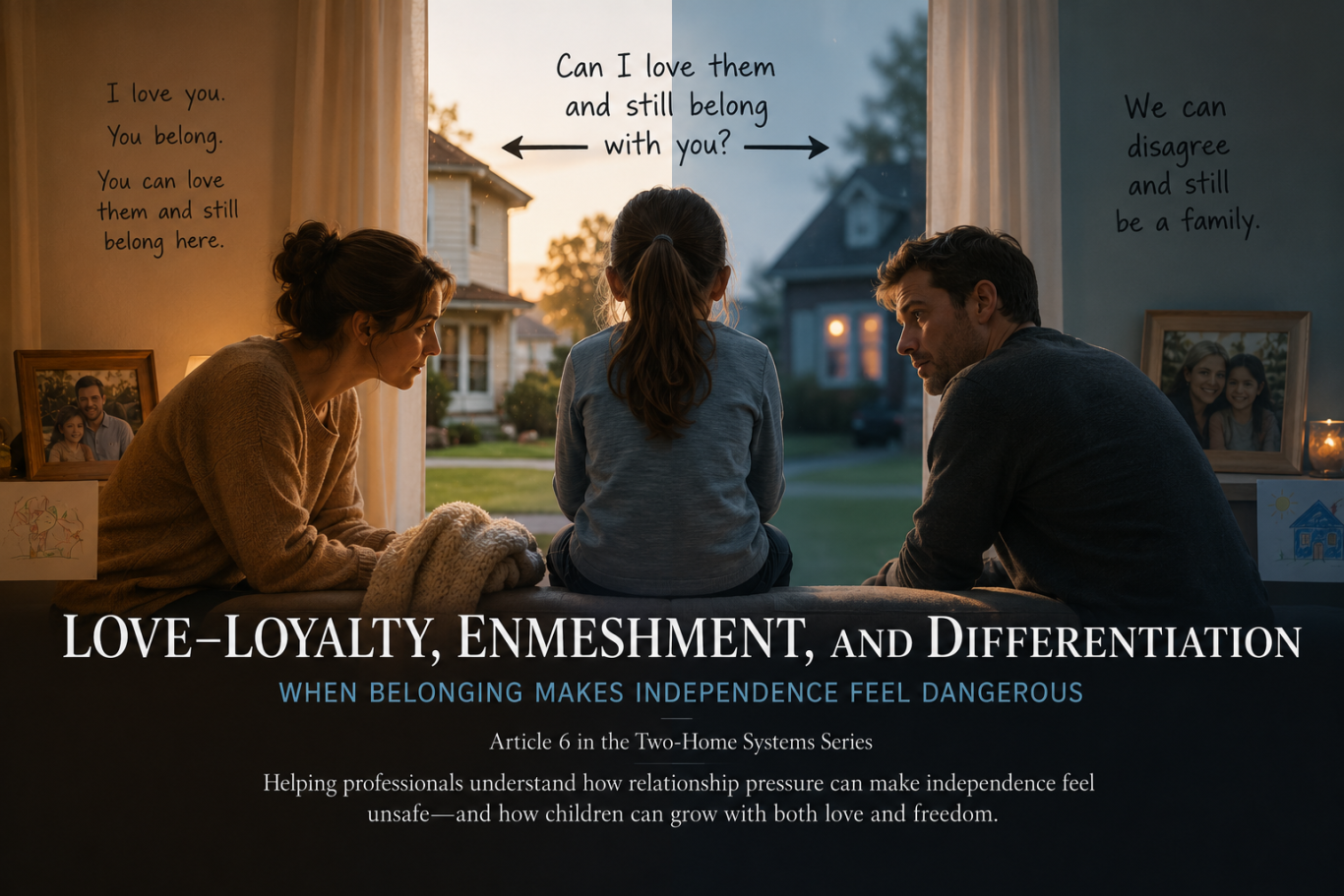
ARTICLE 6
Love–Loyalty, Enmeshment, and Differentiation
When Belonging Makes Independence Feel Dangerous
In Article 3, I introduced the Love–Loyalty Paradox: the possibility that a child living across important relationships may begin to experience love for one person as a threat to belonging with another. In Article 5, we looked at gatekeeping and the ways adults may open, narrow, protect, or close relational pathways around a child. Now I want to slow down and deal with a question I have been asked directly: Is the Love–Loyalty Paradox really something different, or is it simply another name for concepts family therapists already know—enmeshment, fusion, triangulation, or poor differentiation?
That is a fair question, and my answer is no. The Love–Loyalty Paradox is not a replacement for those concepts, and I do not want it used that way. Bowen and Minuchin already gave the field important ways to understand how people lose room for independent thought, become highly reactive inside important relationships, organize around triangles, develop diffuse boundaries, or become caught in coalitions. Those ideas belong to them. What I am trying to name is something more specific that I repeatedly see in two-home family systems: What happens when having an independent relationship begins to feel like it could cost the child belonging somewhere else?
That is the distinction this article is about.
Differentiation Does Not Mean Detachment
Bowen’s concept of differentiation of self is sometimes misunderstood as independence or emotional distance. It is closer to the ability to remain a thinking, distinct person while still staying meaningfully connected to others. People differ in how strongly relationship pressure affects what they think, feel, say, and do, and increased anxiety in a relationship system can make it harder to maintain a separate position while staying connected. Bowen theory also helps us understand triangles—what happens when tension between two people pulls a third person into the emotional field.
That matters tremendously in two-home family systems because children are not learning independence in a vacuum. They are developing inside relationships they depend on. A child does not simply decide one morning to differentiate. Development happens while the child is also asking much more basic questions: Am I safe? Am I loved? Do I belong? What happens when I disagree? Can I be angry and still be connected? Can I become more independent without losing you?
Now add two homes. Can I like what happens at Dad’s house without hurting Mom? Can I disagree with Dad and still belong there? Can I love my stepmother without replacing my mother? Can I want more time with one parent without betraying the other? Can I tell the truth about one home while sitting inside the other?
That is where differentiation becomes more than an abstract family-systems concept. For some children, it becomes a belonging problem.
Enmeshment Gives Us Another Part of the Map
Minuchin’s structural family therapy gives us another important way to understand family organization through boundaries, subsystems, hierarchy, coalitions, and patterns of interaction. Enmeshment describes relationships in which boundaries become overly diffuse and there is too little room for appropriate autonomy. A child may become overly involved in a parent’s emotional life. A parent may have difficulty tolerating the child’s separateness. The child may begin functioning less like a child and more like an emotional protector, confidant, partner, or stabilizer.
That is enmeshment. I do not need another word for it.
What interests me in a two-home family is what may be happening around that pattern. Why does this particular child feel responsible for this particular parent? Why does enjoying the other home create so much tension? Why does a child who once had a relationship with both parents begin to experience one relationship as incompatible with the other? Why does disagreement feel like betrayal instead of ordinary development?
Those questions do not replace structural family therapy. They widen the assessment.
Where I See the Love–Loyalty Paradox Differently
The Love–Loyalty Paradox focuses specifically on belonging and allegiance across important relationships. The child may be perfectly capable of having an independent thought. The problem may be what the child believes will happen relationally if that thought is expressed.
A child might know, “I love Dad,” while also knowing that Mom becomes hurt when Dad is discussed. A teenager might genuinely enjoy time at Mom’s house but believe Dad will experience that as choosing her. A child may deeply love a stepparent and still feel unable to say so because that relationship carries meaning far beyond the relationship itself.
In these situations, the problem is not simply that the child lacks independence. The child may be making a very intelligent relational calculation:
Can I have my own relationship and still keep my place with you?
When the answer feels uncertain, alignment may become safer than differentiation. That is what the Love–Loyalty Paradox adds to the conversation.
This distinction also protects us from overpathologizing close parent-child relationships. Children should be attached to their parents. They should care when a parent hurts. They should have strong family identities. A child wanting comfort from Mom is not enmeshment. A teenager agreeing with Dad is not automatically fusion. A child being closer to one parent during a particular developmental period does not prove a loyalty problem.
The better questions are whether there is room for difference, whether the child can disagree and remain loved, whether the child can maintain another important relationship without paying an emotional price, and whether the child can grow toward greater independence without becoming responsible for the adult’s emotional stability.
That tells us far more than closeness alone.
When Belonging Becomes Linked to Agreement
The pattern becomes more concerning when relationship security starts depending on sameness. The child learns that being close means agreeing, that disagreement creates distance, or that independent relationships cause hurt. A different perspective requires explanation. Enjoyment in the other home needs to be minimized. The parent may never intentionally demand any of this, but children learn from the emotional system around them.
Children are extremely good at noticing what keeps relationships stable. They notice facial expressions, silence, withdrawal, tension, relief, and sudden changes in warmth. They notice which stories receive comfort and which stories change the room. Over time, the child may begin doing more than responding to an adult. The child may begin organizing themselves around the relationship.
They tell less. They agree more. They stop mentioning someone. They become protective. They begin carrying adult explanations. Sometimes they appear unusually mature because they have become very good at managing the emotional field.
And sometimes, as the child grows, that strategy stops working.
Adolescence Can Expose What Childhood Was Able to Hold
This is one reason adolescence deserves special attention. Development naturally asks teenagers to differentiate more. They form stronger peer relationships, question family beliefs, experiment with identity, want more voice, recognize adult contradictions, and begin deciding for themselves what they think.
That is normal development.
But imagine trying to do that inside a relationship in which difference already feels dangerous. The teenager is being asked developmentally to separate at the same time the relational system may be asking for stronger allegiance. A child who managed that tension quietly at eight may begin resisting at thirteen. A teenager may become angrier, shut down, refuse transitions, align more strongly, or suddenly challenge a household they previously appeared comfortable in.
That does not mean the Love–Loyalty Paradox explains every adolescent refusal. Safety concerns, parenting problems, family violence, trauma, ordinary developmental conflict, peer relationships, new family structures, and many other factors may contribute.
But adolescence can expose a question that may have been sitting underneath the system for years:
Can I become more fully myself and still belong here?
That is a differentiation question. In a two-home system, it may also be a Love–Loyalty question.
Triangles Can Travel Across Homes
Bowen’s concept of triangulation is especially useful here because tension does not have to stay between two people. When a relationship becomes stressed, a third person can become part of the emotional system. In a two-home family, those triangles can stretch across households.
Mom and Dad are in conflict, and the child gets pulled in. Dad and stepmom are struggling, and the problem becomes Mom. Mom and child are tense, and Dad becomes the safer alliance. A stepparent feels powerless, the biological parent tries to protect the new marriage, and the child becomes the focus. A therapist enters the case and gradually becomes part of one household’s understanding of the other. A school becomes the place where competing parental narratives are argued.
The triangle is no longer contained in one living room. It travels.
That is one reason Two-Home Systems literacy matters. A professional may be working with only one person or one household and still become part of a much larger system. The question is not whether triangles exist. They do. The question is what they are carrying and whether the child has become the easiest place for unresolved relational tension to land.
How Gatekeeping Can Reinforce the Pattern
This is where Article 5 connects back in. Gatekeeping describes what happens around access, information, communication, and relationships. The Love–Loyalty Paradox describes what some of those relational conditions may begin to mean inside the child. Differentiation helps us understand whether the child can maintain an independent relationship and perspective while remaining emotionally connected.
A child wants an independent relationship with the other parent. The gate narrows. The child experiences tension and pulls back. The parent who narrowed the gate sees that withdrawal and believes the restriction was justified. The other parent reacts strongly, which becomes more evidence that the gate needed to close. The child now has even less room.
Alignment becomes easier. Differentiation becomes harder.
In some systems, the pathway may look something like this: relational anxiety rises; belonging begins to feel connected to allegiance; the child experiences a Love–Loyalty dilemma; independent attachment becomes emotionally costly; triangulation, coalition, fusion, or enmeshed boundaries may intensify; and restrictive gatekeeping may further reinforce the organization.
That is a possible systems pathway. It is not a formula, a diagnosis, or permission to conclude that a close parent-child relationship is unhealthy. It is a way of asking what may be maintaining a pattern once we begin to see it.
A Common Clinical Error: Asking the Child to Differentiate From a System That Punishes Differentiation
We tell children to use their voice. We encourage them to tell Mom how they feel, tell Dad what they need, set a boundary, or say what they really think. Those may be excellent interventions.
But I want us to ask one more question first: What happens to this child when they do?
If expressing a different opinion reliably leads to withdrawal, anger, interrogation, guilt, increased conflict, or fear of losing connection, then we cannot treat differentiation as though it is simply a skill the child has failed to learn. Sometimes the child already knows how to speak. The child does not feel relationally safe enough to do it.
That changes the formulation.
We may still help the child build a stronger sense of self, but we also need to understand the relationship system that makes having a self so expensive. Otherwise, we risk telling a child to become more independent while repeatedly sending them back into a system that experiences independence as betrayal.
What I Want Professionals and Families to Notice
When I see a child who is extremely aligned, highly protective of one adult, unusually responsible for a parent’s emotions, or unable to acknowledge anything positive about another important relationship, I do not want to jump immediately to a label. I want to get curious.
Can this child disagree with this parent? Can the child maintain affection for someone else? What happens when they do? Is there room for developmental independence? Does the child believe another person’s emotional stability depends on them? Is the child carrying language, fears, or responsibilities that seem larger than their developmental role? Are there legitimate safety reasons for the child’s distance? What does each adult do when the child expresses a different experience? And, importantly, are we as professionals being invited into the triangle?
The goal is not to prove a Love–Loyalty Paradox. The goal is to understand enough of the relational system that we do not confuse adaptation with pathology, closeness with enmeshment, distance with independence, or alignment with truth.
For families, the message is equally important. Loving your child includes making room for your child to become different from you. That can be hard in any family, and it can be especially difficult after divorce, betrayal, years of conflict, remarriage, or court involvement. But your child’s independent relationship is not automatically a rejection of you.
Your child can love the other parent without loving you less. They can enjoy another household without preferring a different family. They can love a stepparent without replacing you. They can disagree with you without becoming disloyal. They can become more independent and still belong.
Healthy belonging leaves enough room for a child to become a separate person and still know they have a place in the family.
The Distinction I Want Us to Keep
These concepts fit together, but they are not interchangeable. Differentiation helps us understand a person’s ability to remain a distinct self while staying emotionally connected. Triangulation helps us see how relationship tension moves through a third person. Enmeshment helps us recognize overly diffuse boundaries and insufficient room for autonomy. Gatekeeping helps us observe adult behaviors that may facilitate, restrict, or protect relational pathways.
The Love–Loyalty Paradox asks whether, in some two-home systems, the perceived threat of losing belonging may make independent attachment, differentiation, or relational freedom emotionally costly. The Two-Home Systems lens then asks how all of those processes may be interacting across multiple connected households.
I do not see that as replacing family-systems theory.
I see it as taking family-systems theory seriously enough to follow the system across the front door of the other home.
At the center of this work is still one very simple question:
What is this child required to do relationally in order to feel that they still belong?
If the answer is nothing, if the child can love, disagree, develop, and remain connected—we are looking at something very different from a system in which belonging increasingly depends on agreement, protection, silence, or rejection of another relationship.
Our goal is not independence without connection, and it is not connection without independence. We want children to experience both. They should be able to grow into themselves and remain securely connected to the people they love.
That is what healthy differentiation makes possible.
And in a two-home family, protecting that developmental freedom sometimes requires us to understand more than what is happening inside one home.
Bridge to Article 7
Once we start looking at systems this way, another problem becomes easier to see. Professionals may understand that both parents are part of a family system and then accidentally make a different mistake: assuming that because two adults are involved, both must be contributing equally to the problem.
They may not be.
Two people can participate in the same system while their behaviors, functions, risks, and responsibilities are very different.
That takes us to False Symmetry.
Article 7: False Symmetry in Two-Home Conflict
When “Both Parents” Is Not an Adequate Formulation
Citation Note
The Love–Loyalty Paradox is an applied Sternes Two-Home Clinical Framework. It does not replace or rename Bowen’s concepts of differentiation, emotional interdependence, or triangles, nor Minuchin’s structural concepts of boundaries, hierarchy, subsystems, coalitions, or enmeshment.
The framework proposes a narrower Two-Home Systems hypothesis: that in some family systems, a child’s perceived threat of losing belonging may make independent attachment, differentiation, or relational freedom emotionally costly.
This is a professional organizing hypothesis to be explored through assessment. It is not a diagnosis, an established causal mechanism, a validated forensic construct, or a conclusion that should be inferred solely from a child’s closeness, alignment, resistance, or contact preferences.
References
Bowen, M. (1978). Family therapy in clinical practice. Jason Aronson.
Bowen Center for the Study of the Family. (n.d.). Differentiation of self.
Bowen Center for the Study of the Family. (n.d.). Triangles.
Minuchin, S. (1974). Families and family therapy. Harvard University Press.
Papernow, P. L. (2013). Surviving and thriving in stepfamily relationships: What works and what doesn’t. Routledge.
Papernow, P. L. (2018). Clinical guidelines for working with stepfamilies: What family, couple, individual, and child therapists need to know. Family Process, 57(1), 25–51.
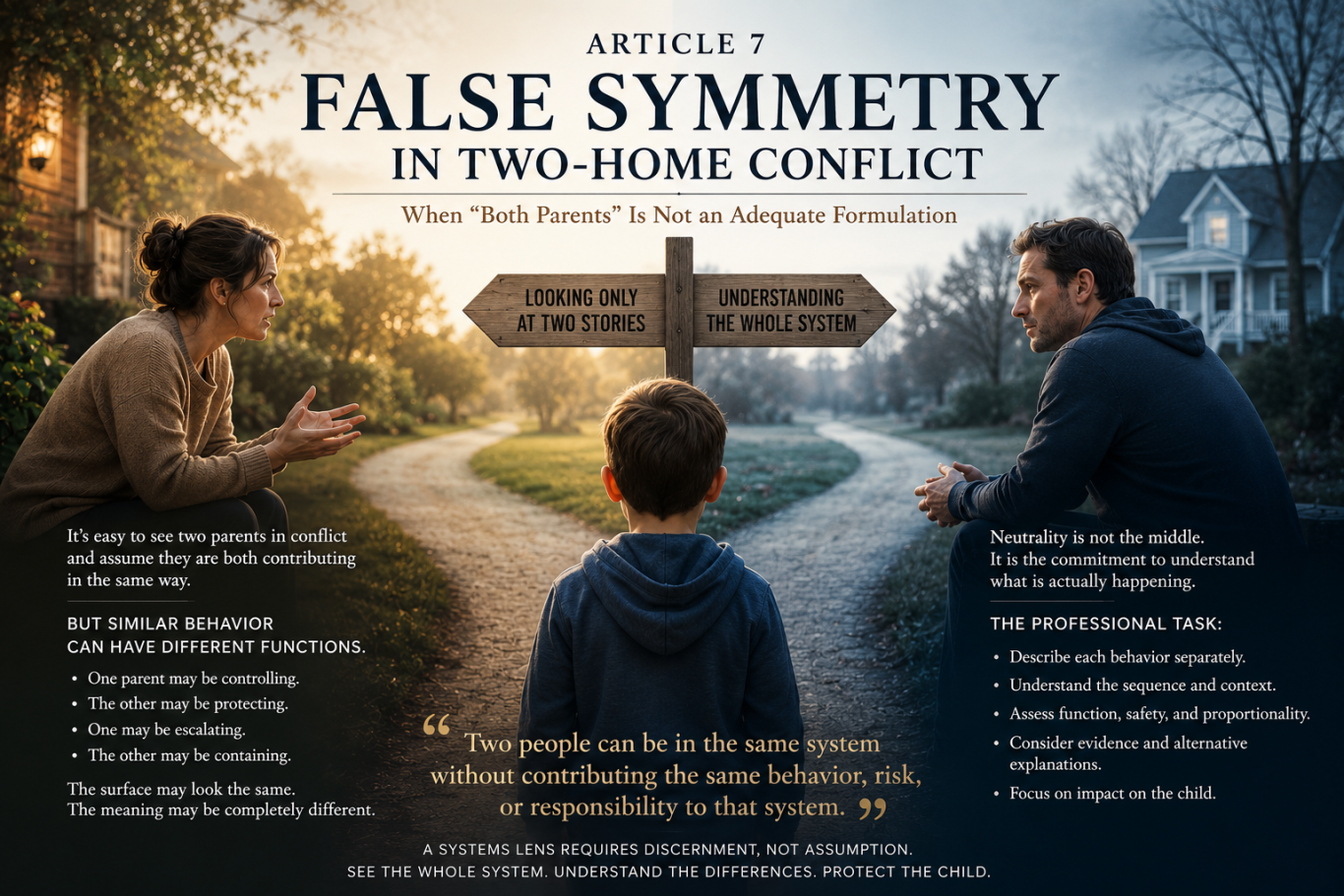
ARTICLE 7
False Symmetry in Two-Home Conflict
When “Both Parents” Is Not an Adequate Formulation
Family-systems work teaches us to look beyond one person. That is one of its greatest strengths. When a child is struggling, we widen the lens and look at relationships, patterns, boundaries, triangles, reactions, and the larger system surrounding the child. But there is a mistake we can make while trying to be systemic: we can see two parents involved in the same conflict and assume that both must be contributing to it in roughly the same way.
Sometimes they are. Sometimes they are not. That is what I call False Symmetry in Two-Home Conflict.
Two people can be part of the same system without contributing the same behavior, function, risk, or responsibility to that system.
That distinction sounds simple. In practice, it can be very difficult to hold, especially when professionals are trying hard not to take sides.
Why We Are Drawn Toward the Middle
Helping professionals are trained to listen to multiple perspectives. We want to remain neutral. We do not want to become aligned with one parent against the other. We know that every person brings a perspective, and we know that conflict can become circular and self-reinforcing.
All of that matters. The problem comes when neutrality becomes a search for the middle.
Mom says Dad is controlling. Dad says Mom is controlling. The professional concludes that they are both controlling. Dad says Mom withholds information. Mom says Dad communicates excessively. The professional concludes that they both need to communicate better. One parent reports intimidation while the other reports that the first parent is uncooperative, and the recommendation becomes, “You both need to put the conflict aside for the children.”
Maybe that is accurate. But maybe it is not.
The fact that two people disagree does not tell us that the truth, the risk, or the responsibility sits halfway between them. Neutrality is not finding the midpoint between two stories. Neutrality is doing the work required to understand what is actually happening.
A System Does Not Mean Equal Causation
This is an important distinction in Two-Home Systems work. When I say we need to understand the whole system, I am not saying that everyone in the system is equally responsible for what is happening.
Systems are interactive. One person’s behavior affects what another person does next. Reactions create more reactions. Patterns can become circular. But circular does not mean equal.
Imagine one parent repeatedly sends hostile or intimidating messages. The other eventually stops answering the phone and requires all communication to go through a parenting application. By the time a professional enters the case, both parents have changed how they communicate. It would be easy to write, “Both parents are rigid and unwilling to communicate.”
But that misses the sequence.
One behavior may be an attempt to control or intimidate. The other may be an attempt to contain the conflict. They are interacting with one another, but they are not necessarily performing the same function.
That is why I want professionals to ask more than, “What is happening now?” We also need to know what happened before it, what each behavior appears to accomplish, what happens next, and what the child experiences inside that sequence.
Similar Behavior Can Serve Very Different Functions
False Symmetry becomes especially important when two behaviors look similar on paper.
Two parents may both insist on following the parenting plan exactly. One may be doing so because years of unpredictable changes have created chaos for the child. The other may be using technical details of the order to create unnecessary obstacles.
Two parents may both restrict communication. One may be containing repeated verbal aggression. The other may be withholding information the other parent reasonably needs.
Two parents may both refuse a schedule change. One may have a legitimate work or child-related reason. The other may routinely refuse flexibility because any accommodation feels like giving something to the enemy.
Two parents may both want the child in counseling. One may be concerned about the child’s functioning. The other may want the therapist to confirm a conclusion already reached about the other household.
The surface behavior can look very similar while the function is very different. That is why behavior alone is not enough. We also need context, sequence, function, proportionality, evidence, and impact.
Safety Is Where False Symmetry Can Become Dangerous
This distinction becomes even more important when safety concerns are present.
A parent may limit direct contact because there has been coercive control, intimidation, stalking, family violence, credible threats, or another serious concern. The other parent may describe that boundary as proof that the first parent “refuses to co-parent.”
If we respond by telling both parents to communicate more, we may accidentally remove a boundary that exists for a legitimate reason.
At the same time, claims of safety should not automatically end our inquiry. A parent can genuinely believe they are protecting a child and still use restrictions that are broader than the concern supports. Saying, “I am protecting my child,” gives us important information. It is not, by itself, the end of the assessment.
This is why the question is not simply whether a parent is restricting something. We need to know what the concern is, what supports it, whether the response is proportionate, whether safer alternatives exist, and what effect the restriction is having on the child.
False Symmetry asks us to resist both errors: assuming every restriction is harmful and assuming every restriction described as protective is justified.
“High Conflict” Can Hide More Than It Explains
I am also careful with the phrase high-conflict parents.
Sometimes it fits. Two adults may both repeatedly escalate, retaliate, undermine, and pull the child into the dispute. But sometimes “high conflict” becomes a container that hides the actual structure of the problem.
One parent may repeatedly initiate conflict while the other reacts poorly. One may pursue while the other withdraws. One may provoke and the other explode. One may restrict while the other overpursues. One may establish distance because of fear while the other interprets that distance as hostility.
None of this means that a reactive parent has no responsibility for their own behavior. Adults remain responsible for what they do. But the treatment plan changes when we understand the sequence.
If I tell two adults, “You both need to calm down,” when one is repeatedly creating the conditions that organize the cycle, I have not remained neutral. I may simply have missed the structure.
Calling both parents “high conflict” can describe the atmosphere while still failing to explain the system.
I want us to go one step further: What is each person actually doing? What happens first? What happens next? What keeps the cycle going? Where does the child end up?
False Symmetry, Gatekeeping, and Love–Loyalty
Gatekeeping is a good example of why this matters. As we discussed in Article 5, two parents can both close a gate while serving completely different functions. One parent may move exchanges to a public location because interactions have become intimidating. Another may make exchanges unnecessarily difficult in order to interfere with the other parent’s contact. Both changed the exchange. The function is not the same.
The same is true with communication. One parent may require a parenting application because direct contact repeatedly becomes abusive. Another may refuse to provide routine information through any channel. Both have narrowed communication. Again, the function is not the same.
This is why a gatekeeping assessment cannot stop at, “Both parents restrict things.” We need to know what is being restricted, why, what supports the concern, whether the response is proportionate, and what happens to the child.
False Symmetry also matters when we assess child alignment. A child may appear strongly aligned with one parent and distant from the other. The distant parent begins pursuing harder. The aligned parent becomes increasingly protective. The child withdraws further. It would be easy to say, “Everyone is contributing.”
At one level, everyone may now be participating in the pattern. But that still does not tell us how the pattern formed or what each person is contributing to it.
Perhaps the child has a legitimate reason to fear the pursuing parent. Perhaps the protective parent’s restriction has grown far beyond any current safety concern. Perhaps the child has become responsible for protecting one parent emotionally. Perhaps the other parent’s desperation has become intrusive and is making repair harder. Several of those things can be true at once.
The Love–Loyalty Paradox asks what the child may believe they need to do in order to preserve belonging. False Symmetry reminds us not to assume that every adult contributed equally to creating that dilemma.
We need the whole system. But we still need discernment.
The Reactive Cycle Does Not Erase the Sequence
Two-home systems can become so reactive that eventually it becomes difficult to see where anything started. One parent acts, the other responds, the first reacts to that response, and the second reacts again. Months or years later, everyone may be doing things they would not have done at the beginning.
That is exactly why we should keep asking about sequence.
Suppose one parent repeatedly withholdss information. The other begins sending excessive messages trying to obtain it. The first parent then points to the excessive messaging as proof that communication must be restricted further. The second becomes more frantic and eventually hostile.
By the time a therapist, mediator, or court sees the family, there may be problematic behavior on both sides.
The professional does not need to excuse the hostility. But we should still understand how the pattern became organized. Otherwise, we risk treating the latest reaction as though it explains the whole system.
A reaction can become unhealthy without becoming equivalent to the behavior that helped organize the reaction.
This leads directly into another Sternes framework, the Reactive Mirror Effect, because over time people can begin reacting to one another in ways that seem to confirm what each already believed about the other.
A Common Clinical Error: Treating Both Sides the Same in the Name of Neutrality
I see False Symmetry most often when professionals are afraid of appearing biased. The response becomes giving both parents the same homework: both need to communicate better, both need to stop talking negatively, both need to be more flexible, both need to support the other relationship.
Sometimes that is exactly right.
But interventions should follow assessment, not replace it.
If one parent is already sharing necessary information while the other is withholding it, giving both the same communication assignment does not address the problem. If one parent consistently supports the child’s relationship with the other and the other makes the child feel guilty for maintaining that relationship, telling both parents to “support the other parent” creates a false equivalence. If one parent has established a reasonable safety boundary and the other repeatedly violates it, asking both to compromise may actually increase risk.
Equal treatment is not always equitable treatment.
Neutrality requires fair assessment of all available information. It does not require assuming equal causation.
That is the principle I want professionals to remember.
What I Want Professionals to Look For
When a two-home case starts sounding like “he said/she said,” slow down. Describe each behavior separately. What did Parent A actually do? What did Parent B actually do? What happened first? What followed? Is the behavior occasional or repeated? Is there an identifiable safety concern? What function does each behavior serve? Is the response proportionate? Who benefits from the pattern? Who carries the cost?
Then look at the child. Is the child carrying information, adult emotions, evidence, secrets, allegiance, or decisions that belong to adults? Does the child behave differently depending on which household or relationship they are in? Is there room for the child to have their own experience?
And then look at yourself. Which story did you hear first? Who referred the case? Who is paying? Which parent seems calmer in the room? Which parent communicates more convincingly? Have you mistaken calmness for accuracy or emotional intensity for unreliability? Are you beginning to rescue someone, defend someone, or prove something?
Once professionals enter a family system, we are no longer completely outside of it. That requires humility.
For Families and Court-Facing Professionals
Parents sometimes hear a systems explanation and think, “If you are saying this is a system, you must be saying I caused half of it.”
No.
That is not what a systems lens means.
A systems lens asks how people are connected, how behavior moves through those connections, and where the cycle might be interrupted. You are responsible for your behavior. You are not automatically responsible for half of every problem simply because another adult is also involved.
At the same time, someone else’s harmful behavior does not remove your responsibility for your own response. You may not have created the original problem and still become part of maintaining it. You may have been genuinely hurt and still begin reacting in ways that hurt the child. Both things can be true.
Court-facing professionals need the same discipline. Words such as high conflict, poor communication, unable to co-parent, and both parents may describe something real, but they should not become the end of the assessment. We still need to describe behavior, understand sequence, assess safety, examine evidence, consider alternative explanations, look at function, and identify the impact on the child.
Two adults can stand in the same courtroom and still be contributing very different things to the problem before the court.
Neutrality is not the absence of discernment.
The False Symmetry Principle
Within the Sternes Two-Home Clinical Frameworks, False Symmetry describes the error of assuming that because two adults participate in the same relational system, their behaviors, functions, risks, motivations, or contributions must be equivalent.
Sometimes both parents contribute similarly. Sometimes one contributes more. Sometimes each contributes differently. Sometimes one behavior is an escalation and another is an attempt at protection. Sometimes a protective response later becomes excessive. Sometimes someone who did not create the original problem begins participating in a reactive cycle that now also requires intervention.
Our job is not to force the family into a balanced story simply because balance feels neutral.
Our job is to understand the family accurately enough to help.
That requires more than asking, “Who is right?” But it also requires more than saying, “Everyone is wrong.”
The better questions are: What is actually happening? What function does each behavior serve? What is the sequence? What is supported by the information we have? What is the child experiencing? And where is change actually needed?
That is not taking sides.
That is doing systems work.
Bridge to Article 8
False Symmetry helps us stop assuming that two people inside the same cycle are doing the same thing. But another question follows: What happens after people have been reacting to one another for so long that each begins to look like the very thing the other expected them to be?
One parent expects hostility and becomes defensive. The defensiveness invites more hostility. One expects control and becomes rigid. The rigidity invites more attempts to control the situation. Each person then points to the other’s reaction as proof that the original belief was correct.
The system begins reflecting itself back.
That is the Reactive Mirror Effect.
Article 8: The Reactive Mirror Effect
When Each Home’s Reaction Begins Confirming the Other Home’s Story
Citation Note
False Symmetry in Two-Home Conflict is a Sternes Two-Home Clinical Framework describing a professional and relational error in which participation in the same family system is mistaken for equivalent behavior, function, contribution, responsibility, or risk.
The framework does not presume that one parent is primarily responsible in every conflict, nor does it excuse reactive, harmful, or unsafe behavior simply because it occurred in response to something else. It directs professionals to examine behavior, sequence, context, function, evidence, safety, proportionality, and child impact before assuming equal contribution.
False Symmetry is an organizing clinical framework, not a diagnosis, forensic finding, custody standard, or validated assessment instrument.
References
Association of Family and Conciliation Courts, & National Council of Juvenile and Family Court Judges. (2022). AFCC and NCJFCJ joint statement on parent-child contact problems.
Johnston, J. R. (1994). High-conflict divorce. The Future of Children, 4(1), 165–182.
Kelly, J. B., & Emery, R. E. (2003). Children’s adjustment following divorce: Risk and resilience perspectives. Family Relations, 52(4), 352–362. https://doi.org/10.1111/j.1741-3729.2003.00352.x
Sternes, S. (2026). False Symmetry in Two-Home Conflict [Two-Home Clinical Framework].
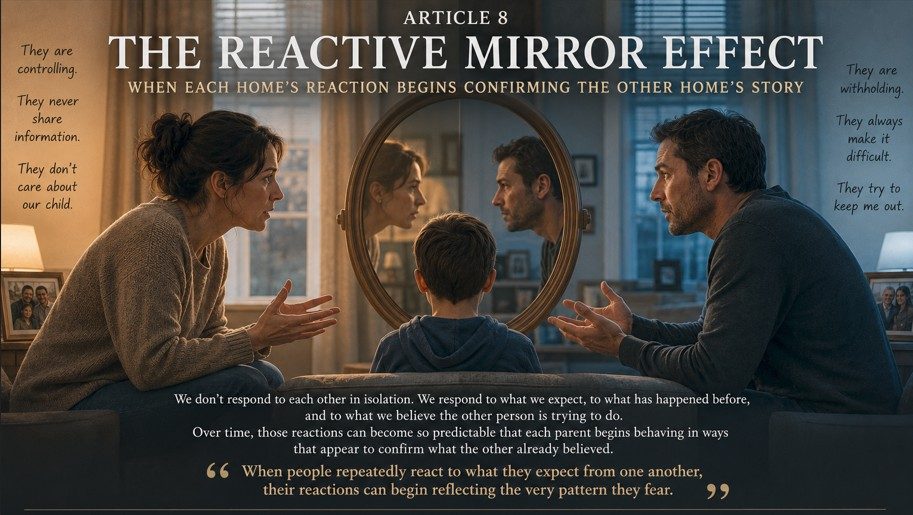
ARTICLE 8
The Reactive Mirror Effect
When Each Home’s Reaction Begins Confirming the Other Home’s Story
By the time many two-home families reach a counselor, mediator, parenting coordinator, or court, the conflict has usually been going on for a long time. Each parent has a story about the other. One is controlling. One is impossible to communicate with. One is irresponsible. One is rigid. One is withholding. One is hostile. Often, by the time we meet the family, we can find behavior that seems to support both stories.
That is where things get complicated. People do not respond to one another in isolation. They react to what has already happened, what they expect will happen next, and what they believe the other person is trying to do. Over time, those reactions can become so predictable that people begin behaving in ways that appear to confirm what others already believed about them.
I have called this the Reactive Mirror Effect: when people repeatedly react to what they expect from one another, their reactions can begin reflecting the very pattern they fear. The danger is that once the mirror is established, everyone can point to the reflection as proof.
But there may be something happening even earlier.
What happens when an ordinary interaction occurs in one home, travels through the other home, and comes back to the child carrying a different meaning? The event may not have changed. The meaning assigned to it did.
I call this Cross-Home Meaning Distortion.
When the Event and the Meaning Begin to Separate
Consider a child who tells Mom that Stepmom called him “dude.” In Dad’s home, “dude” is playful and familiar. It is a word used affectionately with all of the children, and the child may not initially experience the interaction as hurtful. Then someone responds, “She called you a name?”
The event is still the same. Stepmom said, “Come on, dude.” But something has been added to the child’s understanding of what occurred. The child may return to Dad’s house no longer carrying the experience, “Stepmom called me dude,” but instead carrying the meaning, “Stepmom calls me names.”
Cross-Home Meaning Distortion is a practice-informed Two-Home Systems concept describing what may happen when an interaction in one household is given an altered, amplified, or unsupported meaning, motive, or intention in another household, and that interpretation travels back with the child.
Adults naturally help children make sense of their experiences. Children need that. A young child may misunderstand an interaction. An older child may need help understanding a difficult relationship. A teenager may need support making sense of behavior that is genuinely troubling or unsafe. The concern is not that adults interpret experiences for children. The more important question is what happens when the interpretation begins to move beyond what the event and available context support.
A parent spends time alone with a spouse, and the meaning becomes, “Dad loves her more than he loves you.” A stepparent reinforces an ordinary household expectation, and the meaning becomes, “He isn’t your real dad. He has no right to tell you what to do.” Mom says no to an activity, and the meaning becomes, “She doesn’t want you to have fun.” A child cries because they miss Mom while staying with Dad, and the meaning becomes, “You obviously don’t want to be there.”
In each of these examples, something happened and someone assigned meaning to what happened. Those two things are not necessarily the same.
This distinction also requires caution. Not every different interpretation is distortion. Children may be describing abuse, coercive control, violence, neglect, intimidation, dangerous impairment, or genuinely inappropriate behavior. There may be important context that one household does not know. Cross-Home Meaning Distortion should never become a way to dismiss a child’s fear or explain away legitimate danger.
The professional question, then, is not simply whether an interpretation is true or false. A more useful question may be: How did this meaning form, and what supports it? What actually occurred? What did the child understand at the time? What interpretation was later added? What evidence supports that interpretation? What information complicates it? And what happened to the child’s experience of the relationship after that meaning was introduced?
When Meaning Becomes a Lens
One misunderstanding may remain just that. The concern becomes greater when similar meanings accumulate over time.
“She doesn’t really want you there.” “Dad always chooses them over you.” “They are trying to control you.” “Your stepmom thinks she is your mother.” “You know how your mom is.” “They only did that to hurt me.”
Eventually, the child may stop approaching each new interaction as a separate event. Instead, the interaction is experienced through an existing understanding of the person or household.
A correction is no longer simply a correction. It becomes evidence of control. Couple time becomes evidence that a child has been replaced. A household rule becomes evidence that a stepparent is overstepping. A parent’s disappointment becomes evidence that love is conditional. An ordinary disagreement becomes evidence that someone does not care.
The child may now be experiencing both the interaction occurring in front of them and the meaning they carried into it.
This may also help us understand why a child’s story can appear to change without assuming that the child is intentionally lying. A child might first report, “Stepmom said, ‘Come on, dude.’” Later the child may say, “She called me a name.” Still later, the child may say, “People at Dad’s house are always mean to me.”
Those statements are not identical, but the child may sincerely experience all three as true. Once an interpretation becomes emotionally meaningful, later experiences may be noticed, remembered, and organized through it.
That is why two questions may need to remain separate: What happened? and What has the child come to believe that it means?
Both matter.
When the Meaning Begins Changing the Relationship
Cross-Home Meaning Distortion becomes particularly important when the meaning begins altering the child’s behavior inside the original relationship.
Imagine a child who has come to believe that Dad loves his new wife more than he loves the child. The next time Dad and Stepmom sit together on the couch, go to dinner, or spend time as a couple, the event may no longer feel ordinary. It may now confirm the meaning: “She matters more.”
The child becomes hurt or angry. Dad is confused and responds defensively. He says, “That isn’t true. Why would you even think that?” The child now feels misunderstood. Dad becomes frustrated. The child carries that interaction back to the other home.
At this point, the relationship itself may begin changing.
This is where Cross-Home Meaning Distortion and the Reactive Mirror Effect meet, but it is important not to collapse them into one concept.
Cross-Home Meaning Distortion describes what happens to the meaning. The Reactive Mirror Effect describes what may happen when people repeatedly react to that meaning and their responses begin looking like evidence that the meaning was true.
Return to the original “dude” example. The child goes back to Dad’s home believing that Stepmom calls him names. Now he listens differently. Stepmom says, “Come on, kiddo. Get your shoes.” The child responds, “Stop calling me names.” Stepmom is surprised and becomes defensive. The child becomes upset. Later, the story that travels back is, “She got mad when I told her to stop calling me names.”
Now the original interpretation appears to have new evidence behind it.
Stepmom may become increasingly careful, frustrated, or guarded. The child senses the tension. Interactions become more strained. Eventually, the relationship may genuinely feel different.
The meaning has begun participating in the creation of the evidence that appears to prove it.
Cross-Home Meaning Distortion changes the lens. The Reactive Mirror Effect can eventually create the reflection.
We Have to See the Sequence
The Reactive Mirror Effect is not limited to the child’s relationships. It can also organize the adult relationship between homes.
Imagine that one parent believes the other is controlling. Because control is expected, ordinary questions are interpreted as attempts to dominate. The parent becomes guarded, provides less information, and creates tighter boundaries. The other parent experiences the reduced information as withholding, asks more questions, sends more messages, and pushes harder for clarification. The first parent experiences that pursuit as confirmation of the control they expected and becomes even more restrictive.
Now both parents have evidence. One says, “See? She withholds everything.” The other says, “See? He will not leave me alone.”
The behaviors are real. But the meaning of those behaviors cannot be understood by looking only at the most recent email or text message.
We have to see the sequence.
One parent may expect hostility and enter every conversation defensively. The other feels accused and becomes angry. The anger confirms the expectation of hostility. One parent may expect unreliability and begin micromanaging every detail. The other feels controlled and stops volunteering information. The lack of information confirms the belief that the person cannot be trusted.
One parent may expect exclusion and demand greater involvement. The demands feel intrusive, so the other creates more distance. The distance then confirms that exclusion was the goal all along.
The mirror becomes stronger.
Seeing that circular process does not mean both people created it equally. Sometimes one person clearly initiated a harmful pattern. Sometimes one person’s behavior is substantially more severe. Sometimes the reaction is protective. Sometimes the original concern is accurate. Sometimes there is abuse, coercive control, violence, intimidation, dangerous impairment, or another safety issue that should never be reframed as a mutual communication problem.
The mirror helps us understand interaction. It does not erase responsibility.
This is also where False Symmetry becomes important. Two people may both be participating in a cycle without contributing the same behavior, function, risk, power, or responsibility. Reciprocal does not automatically mean equal.
When the Old Story Starts Controlling the Present
One of the hardest things about longstanding two-home conflict is that people eventually stop responding only to what is happening now. They begin responding to years of history.
A five-minute conversation is no longer five minutes because it carries the last hundred conversations with it. A late pickup becomes proof of years of irresponsibility. A question about school becomes proof of control. A boundary becomes proof of rejection. A mistake becomes proof that nothing has changed.
Once a relationship becomes organized this way, people stop encountering one another freshly. They encounter the person they have learned to expect, respond to that version of the person, and sometimes receive exactly the reaction they anticipated.
This is why caution is important when a professional enters a longstanding case and quickly decides who each person is. The parent sending twenty messages may look controlling. Maybe they are. But perhaps necessary information has repeatedly been withheld and excessive pursuit developed over time. The parent refusing to respond may look uncooperative. Maybe they are. But perhaps communication has been hostile or intrusive for years and withdrawal became the strategy used to reduce escalation. The parent insisting on a detailed schedule may look rigid. Maybe they are. But perhaps repeated unpredictability taught them that flexibility usually ends in conflict.
The purpose of widening the lens is not to excuse unhealthy behavior. Twenty messages can still be excessive. Withdrawal can still become harmful. Rigidity can still hurt the child.
The more useful question may be: How did this behavior become organized?
A reaction can make sense and still become part of the problem. Both things can be true.
When the Child Carries More Than Their Own Relationship
Sometimes the meaning the child is carrying did not originate in the child’s relationship at all. It belongs to the adult co-parenting relationship.
“Dad is controlling.” “Mom is selfish.” “She only does things to hurt me.” “He never cared about this family.”
Those may reflect very real experiences inside the former adult relationship. But what happens when the child begins using that adult history to interpret their own parent-child relationship?
Dad asks about homework and the child hears, “Dad is controlling me too.” Mom changes a schedule and the child hears, “Mom only thinks about herself.” A parenting disagreement becomes, “This is what Dad always does to Mom.”
Now the child may be carrying a relationship that was never theirs to manage.
This is why the question Whose relationship is this? becomes so important.
The child has a relationship with Mom and a relationship with Dad. There may also be relationships with stepparents, siblings, grandparents, and extended family. The adults have a co-parenting relationship with one another. Those relationships influence each other, but they are not interchangeable.
One part of healthier two-home functioning may be protecting the child’s ability to experience each important relationship without requiring that relationship to be completely defined by the adults’ relationship with one another.
That becomes especially important when children are repeatedly taught that people they love are bad. There is a meaningful difference between helping a child understand demonstrated harm and teaching a child to organize an entire relationship around adult hatred.
If Dad is bad, what does it mean that I love him? If Stepmom ruined our family, what does it mean that I like her? If Mom is unsafe, why do I miss her?
Those are not small questions for a child. They sit directly at the intersection of meaning, loyalty, and belonging.
Meaning, Loyalty, and Belonging
Cross-Home Meaning Distortion may therefore overlap with the Love-Loyalty Paradox.
A child returns from Dad’s house excited and says, “We went hiking with Stepmom. It was so fun.” Mom becomes quiet and replies, “I’m glad you had fun. I guess Dad really has his new family now.”
The child may hear a meaning that was never stated directly: My happiness there hurts Mom.
Next time, the child says less. “It was okay.” Later, perhaps, “I didn’t really want to go.”
The child may be changing the story because the story itself has relational consequences.
Cross-Home Meaning Distortion asks what happened to the meaning of the experience. The Love-Loyalty Paradox asks what the child may believe they need to do with that experience in order to preserve belonging.
The deeper question becomes:
Can I have my own experience and still belong with you?
Professionals Can Become Part of the Meaning-Making System
Parents are not the only people who assign meaning.
Professionals do it too.
A child says, “I don’t want to go to Dad’s tonight.” A parent may hear evidence that Dad’s home is unsafe. A therapist may hear anxiety. An attorney may hear a custody preference. A teacher may hear transition difficulty.
The child’s words have not changed. The interpretation has.
Interpretation is part of professional work, so the answer is not to stop interpreting. The challenge is remaining aware of when we move from observation to explanation.
It can be helpful to distinguish three levels of information: What did I observe? What was reported to me? What do I believe it means?
Those are not the same thing.
A therapist may hear months of painful stories from one parent and understandably develop a picture of the other household. Then an email arrives from the other parent, and it may be difficult not to read that email through the story already established. A child therapist may see anxiety before transitions and begin developing a theory about why, while the parent who brought the child to treatment already has an explanation. A school may receive frequent communication from one parent and gradually view the quieter parent as less involved.
No one has to be unethical for this to happen.
Professionals are human beings entering an emotional system that was operating long before they arrived.
The professional question becomes:
Am I observing the pattern, or am I beginning to reflect it back?
And with Cross-Home Meaning Distortion, perhaps another question is needed:
Am I observing meaning, or am I helping create it?
A child’s reaction is important information. It is not automatically proof of one adult’s explanation for that reaction.
What If We Could Intervene Earlier?
This is where Cross-Home Meaning Distortion may offer an earlier place for intervention.
What if the shift in meaning could be noticed before everyone became defensive, before the child felt pressured to choose, and before the Reactive Mirror Effect began producing new evidence?
A child says, “Mom said you care more about Stepmom than me.” The instinctive response might be, “That is ridiculous. Your mother is always trying to turn you against me.”
But now the child is carrying another layer of adult conflict.
A different response might be: “I can see why hearing that would hurt. I love my wife and I love you. Those are different relationships, and loving her does not take love away from you.”
The meaning has been addressed. The other parent has not been attacked. The child has not been recruited into the adult relationship.
I think of this as two-sentence clarity. The goal is not a ten-minute defense or a competing closing argument from the other household. The goal is enough clarity for the child to understand the intention behind the interaction and continue thinking for themselves.
“I called you ‘dude’ because it is playful in our family. I wasn’t trying to insult you.”
“Your stepdad helps enforce rules because he is one of the adults caring for you in this home. That does not change who your dad is.”
“I was disappointed when you didn’t call because I missed you. You are not responsible for taking care of my feelings.”
“I love my spouse and I love you. Those relationships do not compete.”
Then stop.
Perhaps children need less defending and more help distinguishing the event from the interpretation of the event.
What happened? What did you think it meant when it happened? Did someone else understand it differently? What do you know firsthand? What are you still wondering about? Could there be another explanation? How did hearing someone else’s interpretation change how you felt?
The goal is not to replace one household’s meaning with the clinician’s meaning.
The goal is to preserve the child’s ability to have an experience of their own.
Clinical Caution and a Question for Future Research
Cross-Home Meaning Distortion should not become another single-cause explanation for parent-child contact problems.
Children may resist or refuse contact for many reasons, including abuse, harmful parenting, family violence, developmental changes, accumulated relationship injuries, interparental conflict, loyalty pressure, remarriage difficulties, the child’s own preferences, and other factors.
There is currently no evidence demonstrating that Cross-Home Meaning Distortion causes later resist-and-refuse dynamics or that intervening in CHMD prevents them.
But the developmental question seems worth asking.
What happens when a child spends years receiving increasingly negative meanings about one home? What happens when those meanings begin organizing later experiences? What happens when belonging makes one interpretation safer to hold than another? What happens when later adult reactions begin looking like proof of the meaning the child has been carrying?
Could Cross-Home Meaning Distortion contribute to some pathways toward later relationship refusal?
We do not know.
But what if recognizing changes in meaning earlier gave families and professionals another opportunity to protect important relationships before they became much harder to repair?
That is a question worth studying.
A Two-Home Systems Reading
When a child's relationship with one household begins changing, perhaps the first question does not have to be, “Who caused this?”
A broader Two-Home Systems reading asks what happened, what meaning the child initially made of it, what meaning was later added, who helped form that interpretation, and what evidence supports or complicates it. It then asks what happened next. Did the child begin behaving differently? How did the adults respond? Did those responses begin reinforcing the interpretation? Has an old story begun controlling the present? Is the child carrying the adult relationship? Does belonging in one home depend on understanding the other household in a particular way?
And perhaps the most important question is:
Does this child still have room to experience each relationship directly?
Cross-Home Meaning Distortion and the Reactive Mirror Effect help organize different portions of that process.
Cross-Home Meaning Distortion describes a hypothesized movement from event, to interpretation, to meaning, to later experience.
The Reactive Mirror Effect describes a related possible movement from meaning, to reaction, to reciprocal response, to apparent confirmation.
Put simply:
Cross-Home Meaning Distortion changes the lens. Reactive Mirror Effect can eventually create the reflection.
Neither framework tells us who is right. Neither removes responsibility. Neither replaces safety assessment.
They give us more precise questions to ask about what children may be carrying between homes.
Bridge to Article 9
Once we can see how meaning travels, how responses develop, and how a child may become positioned inside the system, another question becomes important: Who is carrying which role?
Who holds attachment? Who carries authority? Who has trust and influence? Who has become the messenger, protector, outsider, disciplinarian, peacekeeper, rescuer, or problem?
In two-home and stepfamily systems, family titles do not always tell us how the family actually functions.
That takes us to Article 9: Relational Role Mapping Across Two Homes, Understanding Who Holds Attachment, Authority, Trust, Influence, and Responsibility.
Citation Note
Cross-Home Meaning Distortion is a Sternes practice-informed Two-Home Clinical Framework describing a hypothesized relational process in which the meaning, motive, or intention assigned to an interaction may change as information moves between households and subsequently influence later interactions or relationships.
The Reactive Mirror Effect is a related Sternes practice-informed Two-Home Clinical Framework describing a potential reciprocal process in which expectations and repeated responses across connected households may become mutually reinforcing and begin producing behaviors that appear to confirm an existing interpretation.
Both frameworks are informed by established family-systems, coparenting, stepfamily, child-appraisal, loyalty, and parent-child contact literature. Neither has been empirically validated as a distinct construct.
Neither framework is a diagnosis, forensic finding, custody standard, determination of alienation or abuse, or validated assessment instrument. Neither assumes equal responsibility within a relational cycle, excuses harmful behavior because it occurred in reaction to something else, or minimizes abuse, coercive control, violence, neglect, or other legitimate safety concerns.
The concepts are intended to encourage more specific examination of events, meanings, sequence, context, evidence, responses, safety, and child impact.
References
Association of Family and Conciliation Courts, & National Council of Juvenile and Family Court Judges. (2022). AFCC and NCJFCJ joint statement on parent-child contact problems.
Bowen, M. (1978). Family therapy in clinical practice. Jason Aronson.
Feinberg, M. E. (2003). The internal structure and ecological context of coparenting: A framework for research and intervention. Parenting: Science and Practice, 3(2), 95–131. https://doi.org/10.1207/S15327922PAR0302_01
Feinberg, M. E., Kan, M. L., & Hetherington, E. M. (2007). The longitudinal influence of coparenting conflict on parental negativity and adolescent maladjustment. Journal of Marriage and Family, 69(3), 687–702. https://doi.org/10.1111/j.1741-3737.2007.00400.x
Grych, J. H., & Fincham, F. D. (1990). Marital conflict and children's adjustment: A cognitive-contextual framework. Psychological Bulletin, 108(2), 267–290. https://doi.org/10.1037/0033-2909.108.2.267
Kelly, J. B., & Emery, R. E. (2003). Children's adjustment following divorce: Risk and resilience perspectives. Family Relations, 52(4), 352–362. https://doi.org/10.1111/j.1741-3729.2003.00352.x
Minuchin, S. (1974). Families and family therapy. Harvard University Press.
Papernow, P. L. (2013). Surviving and thriving in stepfamily relationships: What works and what doesn't. Routledge.
Papernow, P. L. (2018). Clinical guidelines for working with stepfamilies: What family, couple, individual, and child therapists need to know. Family Process, 57(1), 25–51. https://doi.org/10.1111/famp.12321
Sternes, S. (2026). Cross-Home Meaning Distortion [Two-Home Clinical Framework].
Sternes, S. (2026). The Reactive Mirror Effect [Two-Home Clinical Framework].
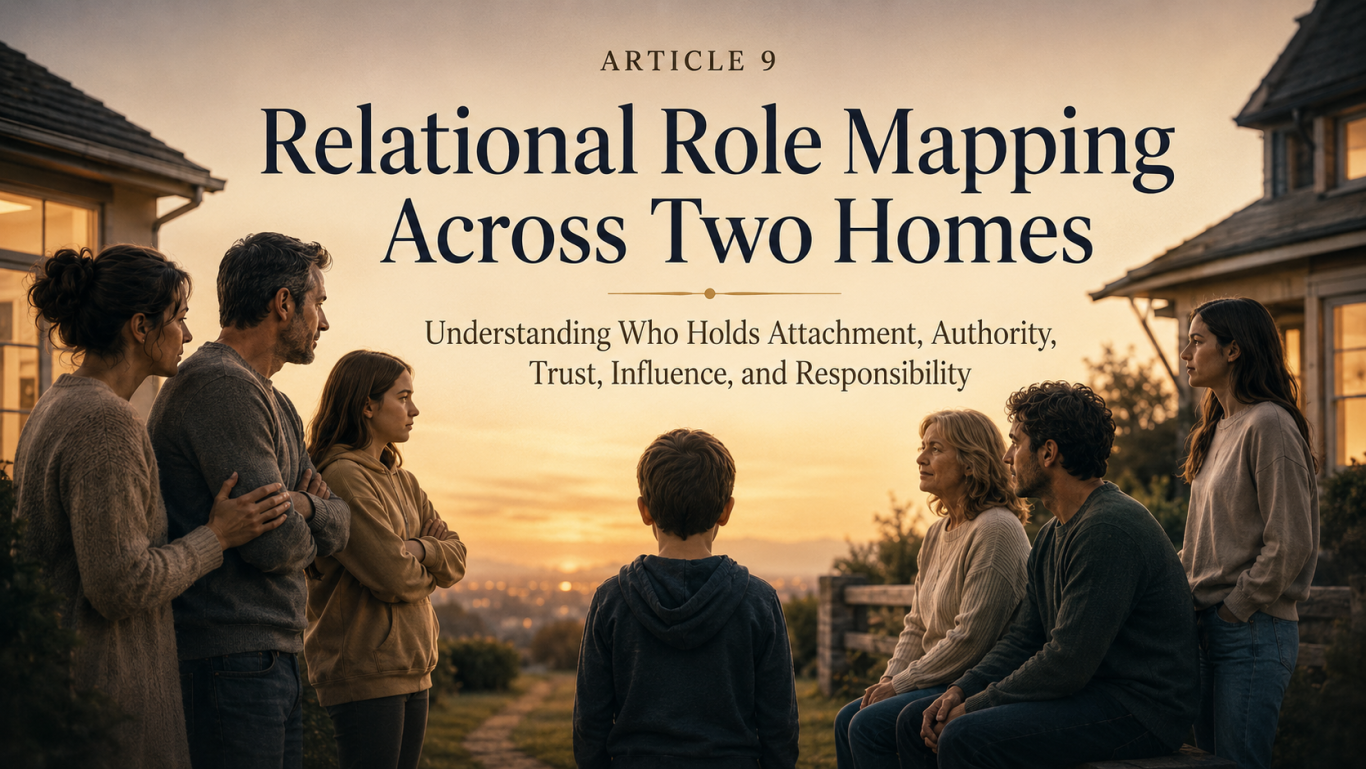
ARTICLE 9
Relational Role Mapping Across Two Homes
Understanding Who Holds Attachment, Authority, Trust, Influence, Information, and Responsibility
A family can look clear on paper and still be confusing to live inside.
Two biological parents. A parenting plan. A stepparent in one home and perhaps another in the other. Grandparents nearby. A therapist, teacher, attorney, mediator, or parent coordinator involved. We can list every person connected to the child and still not understand how the system is actually functioning.
Who does the child turn to for comfort? Who makes decisions? Who carries the schedule? Who is believed? Who can change the emotional weather in a home? Who is expected to protect whom? Who is allowed to be close, and what does that closeness cost somewhere else?
A stepmother may carry daily responsibility without having appropriate authority. A stepfather may become the emotional protector of his spouse and then the frontline communicator with the other parent. A biological parent may hold legal authority but have little current trust. A grandparent may have tremendous influence without appearing anywhere in the parenting plan. And sometimes the child is the only person who knows what is happening in both homes.
Family titles matter.
But titles do not tell us what people are carrying.
I call the process of making those functions visible Relational Role Mapping Across Two Homes.
Family Titles Do Not Tell Us What People Are Carrying
When we hear mother, father, stepparent, grandparent, child, therapist, or teacher, we often assume we understand the role. But family titles describe position in the family. They do not automatically tell us how attachment, authority, trust, influence, information, protection, or responsibility are actually distributed.
A biological parent may be deeply loved but no longer trusted with sensitive information. A stepparent may be trusted and influential but should not be carrying the biological parents' co-parenting conflict. A child may have no formal authority and still control the movement of information between homes because every adult depends on the child to report what happened elsewhere.
One person can hold several roles. Several people can compete for the same role. A role can also change depending on the issue. Dad may hold authority around sports, Mom may hold authority around school, a stepmother may manage medical routines, and a grandmother may quietly influence every major decision.
The important question is not only, "Who is in this family?"
It is:
Who is actually carrying what, for whom, across which boundary, and with what effect on the child?
What Relational Role Mapping Adds
Family therapists already have valuable ways to map systems. Genograms organize family structure and patterns across generations. Structural family maps help us see boundaries, hierarchy, subsystems, alliances, and coalitions. Ecomaps show the family's connections with schools, courts, health care, faith communities, extended family, and other outside systems.
Relational Role Mapping is not a replacement for any of these tools, and it is not a claim that family mapping itself is new.
It is a specific Two-Home Systems integration.
Relational Role Mapping Across Two Homes is a Sternes Two-Home Clinical Framework for identifying how attachment, authority, trust, influence, information, protection, and responsibility are actually distributed across connected households and generations.
The map looks at two homes through three levels of assessment and across three generations. It also distinguishes what is directly observed, what one person reports about another, what is disputed, and what remains unknown.
The map is not simply a picture of relationships. It is a working clinical formulation of role and function.
It asks where the adult leadership system is carrying the work, where it is failing to carry the work, and who has stepped in to hold what was left unattended.
The Three Levels and Three Generations
At Level 1, I look at the individual client. What is this child or adult feeling, believing, managing, and carrying? What symptoms are present? What role has the person taken to preserve safety, connection, belonging, or stability?
At Level 2, I look inside each household. What happens in the parent-child relationship? How is the stepcouple functioning? Who leads discipline? Who provides comfort? Is the stepparent an insider in the couple and an outsider in the parent-child attachment system? Are siblings or stepsiblings being pulled into different alliances? Are the household roles developmentally and structurally workable?
At Level 3, I look between the homes. How does information move? Who carries transitions? Who opens or closes relational gates? Who has influence across household boundaries? How are decisions made? What happens when the homes disagree? Can the child love, miss, enjoy, or disagree with people in either home without relational punishment?
Then I widen the map across three generations.
This does not mean that grandparents caused the current problem. It means that families bring older rules about loyalty, conflict, outsiders, authority, cutoff, reconciliation, gender, parenting, and belonging into the new two-home system.
Who did Mom have to protect in her family? How did Dad's family handle disagreement? Were former partners treated as enemies? Did grandparents step in when parents struggled? Was silence the safest response? Was closeness earned through agreement? Were people cut off when they challenged the family story?
A three-generation view helps us see whether a current role began with this divorce or whether the system is using an older solution in a new family structure.
Separate the Roles We Commonly Collapse
Relational Role Mapping separates roles that are often treated as though they naturally belong together.
Attachment asks: Who does the child seek for comfort, regulation, reassurance, play, and repair? Who does the child miss? Whose disappointment feels most dangerous?
Authority asks: Who has legal authority, daily authority, earned authority, and disciplinary responsibility? Are those forms of authority aligned, divided, or competing?
Trust asks: Whose account is believed? With whom can the child share fear, affection, mistakes, or disagreement? Does the child expect information to be protected, used, challenged, or carried to someone else?
Influence asks: Who can change a decision, mood, schedule, or relationship without holding formal authority? A stepparent, grandparent, sibling, attorney, therapist, or extended family member may have significant influence even when they are not the person officially responsible.
Information asks: Who knows what is happening in both homes? Who controls access to school, medical, legal, and scheduling information? Who is expected to deliver messages? Who keeps secrets, collects evidence, or explains one home to the other?
Responsibility asks: Who does the actual work? Who schedules appointments, manages transitions, packs belongings, communicates with the school, follows through on treatment, and repairs problems after conflict?
Protection asks: Who believes they must protect the child, a parent, a stepparent, or the household itself? Is the protection proportionate to verified risk, or has protection become a role that organizes the family around opposition?
In a well-functioning system, these roles do not have to be perfectly equal. Two homes will never be identical. But the roles should be clear enough and adult-held enough that the child is not required to keep the system moving.
When Children and Stepparents Carry Adult Roles
When the co-parenting relationship does not carry the work between homes, someone else usually begins carrying it.
Very often, that person is the child or a stepparent.
A child may become the messenger, peacekeeper, emotional protector, secret-keeper, witness, judge, rescuer, evidence, or identified problem. The child may remember the schedule because the adults will not communicate. The child may soften information before sharing it. The child may tell each home what that home can tolerate. The child may monitor a parent's face before mentioning a good experience somewhere else.
The child's anxiety, anger, silence, stomachache, perfectionism, or refusal may then be treated only as an individual symptom.
But the behavior may also be helping the child perform a role.
Stepfamilies can become structurally confused in a different way. A stepparent may carry responsibility before attachment has had time to develop. They may become the disciplinarian because the biological parent feels guilty, overwhelmed, or exhausted. They may become the spokesperson to the other home because their partner feels unable to communicate. They may become the investigator, enforcer, buffer, rescuer, or defender of the household.
These roles may develop for understandable reasons. They may even keep the home functioning for a while.
But a role can be understandable and still add strain.
If the adult relationship between homes is not carrying its load, the child or stepparent can become the temporary support beam. Over time, the system may begin depending on the very role that is harming the person carrying it.
The Ally Role: Support or Fuel?
The ally role deserves special attention because it can look like healthy support.
An ally role is not simply caring about someone or standing beside a spouse, child, or client. It develops when support becomes organized around validating one person's understanding of the other home, defending that position, and helping carry the conflict against another relationship.
This overlaps with established family-systems ideas about alliances, coalitions, and triangles. The Two-Home Systems question is where the ally role is operating across households and what it does to the child's freedom of attachment.
Within the proposed Love-Loyalty Paradox, the ally role appears least likely to create additional loyalty pressure in a Love-Love configuration, where support for one relationship does not require alignment against another.
In Love-Love, a spouse, grandparent, friend, or professional can support a person without requiring rejection of the other home. The ally can say, "I am with you, and we still need to protect the child's relationship with the other parent." Support strengthens the adult while preserving the child's freedom to love.
In a Love-Loyalty configuration, the ally role may backfire. The ally may unintentionally strengthen the loyalty-led home's certainty, validate conditional belonging, or turn one household into a team organized against the other parent. What feels like support to the adult may feel like additional pressure to the child.
In a Loyalty-Loyalty configuration, both homes may recruit allies. Stepparents, grandparents, siblings, teachers, therapists, attorneys, and even the child can be pulled into competing camps. Each new ally becomes more proof that the other side is the problem.
The ally role can become gas to the fire.
This distinction matters for clinicians. A therapeutic alliance with our client is essential. Taking an ally role in the client's family conflict is something different. We can believe a client's pain, protect confidentiality, and provide excellent care without accepting one person's map as the complete map of the two-home system.
Confidentiality tells us what we may share. It does not require us to stop thinking systemically.
Transitions Reveal the System
Transitions reveal the system.
They are repeated moments when attachment, authority, trust, information, responsibility, and belonging all become active at the same time. That makes transitions one of the first places I assess and one of the first places I consider intervention.
Who prepares the child to leave? Who carries medications, schoolwork, clothing, and information? Who checks the schedule? Who communicates changes? Does the child watch an adult's face before greeting the other parent? Can the child say goodbye warmly without someone becoming hurt? Is the child questioned afterward? Does a stepparent stand at the center of the handoff because the biological parents cannot tolerate contact? Who is regulating whom?
A difficult transition does not automatically prove that one parent is unsafe, that the child does not want the relationship, or that another parent is creating the distress.
It tells us that the system is activated.
The transition gives us a place to ask better questions and make the first structural changes. Adults can move necessary information through an adult channel. Belongings can be prepared without making the child responsible. Goodbye and hello rituals can become predictable. The child can receive direct permission to love and enjoy people in both homes. Contact can be structured more carefully when safety or conflict requires it.
The goal is not a perfect handoff.
The goal is an adult-held bridge that allows the child to cross without carrying the adults with them.
A Common Clinical Error: Seeing the Client but Not the Role
Clinicians often see the client in front of them and, under the important protection of confidentiality, become reluctant to look beyond that individual experience.
But confidentiality and systemic assessment are not opposites.
Whole-system thinking is not the same as treating the whole system. A clinician may work only with the child, one parent, or one couple and still ask what roles, transitions, pressures, relationships, and information pathways are shaping the client's daily life. We can remain clear about what we directly know, what the client reports, what we have not assessed, and what lies outside our role.
The error is not believing the client.
The error is treating the client's position in the system as though it is the entire system.
An anxious child may need regulation skills. A distressed parent may need support. A stepcouple may need stronger boundaries. But if the child is also the messenger, the parent is carrying authority without trust, or the stepparent has become the co-parenting spokesperson, individual treatment alone may leave the organizing role untouched.
We may help the client tolerate the role more effectively without asking whether the client should be carrying it at all.
From Mapping to Intervention
Good assessment of the two-home system leads to good intervention.
The purpose of Relational Role Mapping is not to create a more complicated picture. It is to identify the clearest place to help.
If the child is carrying information, the intervention is to build a reliable adult information pathway. If a stepparent is carrying primary discipline before attachment has developed, the biological parent may need to reclaim leadership while the stepcouple builds agreement privately. If a parent holds legal authority but has lost trust, increasing power may not repair the relationship. Predictability, accountability, attunement, and repair may be more important.
If grandparents or professionals are carrying more influence than the parenting structure can tolerate, boundaries and roles may need clarification. If one home controls information or access, the function and safety of the gate must be assessed. If the child is protecting an adult from pain, the adult needs enough support that the child can step out of that job.
The goal is not to decide which parent is "wrong" and then protect the child by removing a safe relationship.
The goal is to understand what each adult must learn, carry, stop carrying, or repair so the co-parenting system can become more child-centered.
Both parents may need to change, but the changes may not be the same and they may not be equal. One may need to reduce pursuit. The other may need to provide reliable information. One may need to stop criticizing. The other may need to become more accountable. One may need help tolerating the child's attachment elsewhere. The other may need help creating enough safety for trust to return.
When credible danger exists, child-centered intervention may require protection, structured contact, specialized assessment, or firm boundaries. Safety remains the first question. Relational Role Mapping should never turn abuse, coercive control, violence, dangerous impairment, or serious risk into a shared communication problem.
Sometimes referral is the intervention.
When the child is the only communication bridge, stepparents are leading the co-parenting conflict, professionals have been recruited into opposing camps, repeated treatment has not changed the structure, parent-child contact is collapsing, or credible safety questions exceed the clinician's role, the family may need a higher level of care.
That may include specialized co-parenting work, parenting coordination where appropriate, a comprehensive family or safety assessment, domestic-violence-informed services, court-involved intervention, or consultation with professionals trained for the complexity in front of us.
Referral is not abandonment.
It is an intervention that matches the level of care to the system.
What We Know, What We Are Told, and What We Do Not Know
A responsible role map must preserve the limits of the evidence.
I want the map to distinguish four categories: what has been directly observed or documented, what one person reports about another, what is disputed, and what remains unknown.
Those categories should never be collapsed.
A child says Dad is angry. That matters. It does not tell us whether the clinician observed the anger, whether the child is describing one event or a pattern, what preceded it, or how the statement is understood in each home. A parent says the other household withholds information. That may be accurate. We still need to identify what information, how often, in what context, and whether safety, privacy, or misunderstanding offers another explanation.
Relational Role Mapping is not a lie detector. It is not a custody score. It does not prove causation, determine which parent should have more time, or convert one person's report into a forensic conclusion.
It is a working map that helps us remain curious, behavior-specific, and honest about the difference between information and interpretation.
Roles also change. A map should be updated when people repair, disengage, remarry, move, enter treatment, change schedules, or respond differently. A map that cannot change can become another rigid story about the family.
What I Want Professionals and Families to Notice
When I map roles, I want to ask:
Who is carrying this role? Who assigned it? What problem did the role originally solve? Who benefits from it now? Who pays the cost? What would happen if the role were returned to the adult or relationship that should be holding it?
For families, I want to make this compassionate.
A child who became the messenger may have been trying to keep life moving. A stepparent who became the enforcer may have been trying to protect the household. A parent who took every responsibility may have believed that no one else would follow through. A grandparent who stepped into authority may have been responding to genuine instability.
Understanding the role does not require shaming the person carrying it.
It gives us a way to return the role carefully.
Children can carry their love, their belongings, their stories, and their developing sense of self between homes.
They should not have to carry the adult system.
The Relational Role Mapping Principle
Relational Role Mapping Across Two Homes is a Sternes Two-Home Clinical Framework that integrates established genogram, structural family mapping, ecomap, family-systems, stepfamily, and coparenting traditions into a specific two-home, three-level, three-generation assessment.
It identifies how attachment, authority, trust, influence, information, protection, and responsibility are distributed across connected households. It asks where those roles are clear, where they are misaligned, and where children or peripheral adults have begun carrying work that belongs to the adult leadership system.
The framework is not a diagnosis, validated assessment instrument, custody ranking, forensic finding, or substitute for safety assessment. It is a clinical organizing framework intended to improve formulation, intervention matching, role clarity, and referral decisions.
Family titles tell us who people are.
Relational roles tell us what the system is asking them to carry.
Children should be free to carry relationships between homes, not the adult roles required to keep those homes functioning.
Bridge to Article 10
Once we can see what the child is carrying, another question becomes important:
What happens when the child carries that role across development?
A strategy that reduces distress at one age may become a pattern at the next. Transition monitoring may become compartmentalization. Protecting a parent may become silence. Silence may become alignment. Alignment may later become resistance or refusal.
That progression is not inevitable, and no single pathway explains every child. But developmental burden can accumulate when the system continues asking the child to carry what adults have not yet taken back.
That takes us to The Two-Home Developmental Spiral.
Citation Note
Relational Role Mapping Across Two Homes is a practice-informed Sternes Two-Home Clinical Framework developed in 2026. It builds upon established work involving genograms, structural family mapping, ecomaps, family systems, stepfamily development, coparenting, alliances, coalitions, triangles, boundaries, hierarchy, and intergenerational patterns.
Its proposed contribution is the integration of these traditions into a two-home, three-level, three-generation assessment that separates attachment, authority, trust, influence, information, protection, and responsibility while preserving evidence limits across connected households.
Relational Role Mapping is an organizing clinical framework. It is not a diagnosis, forensic finding, custody standard, validated assessment instrument, or claim that a role map can establish causation or determine parenting time.
References
Association of Family and Conciliation Courts, & National Council of Juvenile and Family Court Judges. (2022). AFCC and NCJFCJ joint statement on parent-child contact problems.
Bowen, M. (1978). Family therapy in clinical practice. Jason Aronson.
Feinberg, M. E. (2003). The internal structure and ecological context of coparenting: A framework for research and intervention. Parenting: Science and Practice, 3(2), 95-131. https://doi.org/10.1207/S15327922PAR0302_01
Hartman, A. (1978). Diagrammatic assessment of family relationships. Social Casework, 59(8), 465-476. https://doi.org/10.1177/104438947805900803
McGoldrick, M., Gerson, R., & Petry, S. (2020). Genograms: Assessment and treatment (4th ed.). W. W. Norton.
Minuchin, S. (1974). Families and family therapy. Harvard University Press.
Papernow, P. L. (2013). Surviving and thriving in stepfamily relationships: What works and what doesn't. Routledge.
Papernow, P. L. (2018). Clinical guidelines for working with stepfamilies: What family, couple, individual, and child therapists need to know. Family Process, 57(1), 25-51. https://doi.org/10.1111/famp.12321
Sternes, S. (2026). Relational Role Mapping Across Two Homes [Two-Home Clinical Framework].
StephSternes.com |
ARTICLE 10
The Two-Home Developmental Spiral
How Early Adaptations May Become Later Alignment, Resistance, or Refusal
The same goodbye can mean something very different at two, six, eleven, or fifteen.
A two-year-old may feel the goodbye in the body. The child may cry, cling, become quiet, stop eating, wake at night, or struggle to settle after the transition.
A six-year-old may understand that both homes still exist, but begin watching each parent's face before talking about the other one.
An eleven-year-old may become preoccupied with what is fair, who is telling the truth, and why the adults cannot agree.
A fifteen-year-old may finally have enough voice, mobility, and social power to say, "I am not going."
From the outside, those can look like separate problems at separate ages.
From inside the child's one life, they may be connected.
The child did not stop living in the two-home system when the transition ended. The child grew inside it.
The Crossing Remains Constant. The Child Grows.
Children do not move through development in five clean boxes. Development overlaps. Earlier needs return. New abilities change the meaning of old experiences. A child who handled separation well at four may struggle again after a remarriage, a move, a new sibling, a court change, a parent's illness, or a period of increased conflict.
But development still matters.
Piaget described major changes in how children think, moving from experience-based and symbolic thinking toward concrete logic and later abstract thought. Erikson described major relational and identity tasks, including autonomy, initiative, competence, and identity. These theories are established developmental foundations. They are not Two-Home Family Systems concepts, and the ages are guides rather than rigid deadlines (Piaget & Inhelder, 1969; Erikson, 1950, 1968).
Research on divorce, interparental conflict, coparenting, emotional security, role burden, and parent-child contact problems also tells us that age, development, safety, parenting, and family context matter. The AFCC and NCJFCJ joint statement specifically directs professionals to consider what is normal for the child's age and developmental stage before interpreting contact problems or applying a label (AFCC & NCJFCJ, 2022).
My proposed contribution is not the discovery of developmental stages. We already know a great deal about development. The proposed contribution is using development as the first foundation for a Two-Home Family Systems assessment.
Before we blame the other home, we ask what is normal at this age.
What is the child expected to be learning now? What has changed because the child is older? What two-home task is the child trying to master? Is an earlier task still active underneath the current behavior? What intervention or repair fits that task?
I use the Two-Home Developmental Spiral to organize those questions across the child's one life.
The Two-Home Developmental Spiral is a Sternes Two-Home Clinical Framework describing how a stage-specific two-home task, and the adaptation a child uses when that task is not made safe enough, may return, layer, and change form as the child grows across connected homes.
I call it a spiral rather than a staircase because children do not simply move upward and leave earlier needs behind. They revisit separation, predictability, belonging, fairness, identity, and attachment from new developmental positions.
The crossing remains constant.
The child grows.
What the Spiral Is, and What It Is Not
The spiral is a clinical hypothesis about development, assessment, intervention, and repair.
It asks whether a child may enter a new stage carrying two things:
The earlier task that was never made secure enough.
And the adaptation that helped the child manage it.
A young child who cannot trust the transition may begin watching the adults. A child who watches the adults may learn to keep information and affection separate between homes. A child who keeps the two worlds separate may begin protecting adults from what cannot safely be said. Protection may become responsibility. Responsibility may become feeling caught. Feeling caught may become alignment with the relational world that feels most necessary. With adolescent autonomy, alignment may become resistance or refusal.
That is one possible pathway.
It is not the only pathway.
The spiral is not a diagnosis, a fixed sequence, or a prediction that a young child's distress will become later rejection. It does not prove that one parent caused an outcome. It does not mean every difficult transition creates damage or that every adolescent who resists contact has been caught in a loyalty bind.
It gives us a developmental question:
What did this child need at each stage, what did the system repeatedly ask the child to carry instead, and what adaptation is still doing work now?
Begin With What Is Normal
Development gives professionals and parents a place to begin that is more useful than blame.
A toddler's distress at goodbye can be normal separation distress. A preschooler's repeated questions can reflect an immature understanding of time. A school-age child's comparisons can reflect growing concrete thinking. A preteen's focus on fairness can be developmentally expected. A teenager's stronger investment in friends, sports, school, work, privacy, sleep, and control over time can be part of normal autonomy and identity development.
None of those normal patterns tells us that the other home caused a problem.
They also do not rule out a problem.
Development helps us ask better questions. Is this expected for the child's age? Is the behavior unusually intense, persistent, or impairing? Is the child responding to ordinary growth, a poor schedule fit, relationship injury, adult conflict, loyalty pressure, safety concerns, or more than one of these?
Normal development is the first assessment lens, not the last excuse.
It helps keep professionals and parents from falling into the trap of using every new behavior as evidence against the other home.
Stage 1: Ages 2-3, Emotional Foundation
Developmental foundation. This stage falls near Piaget's move from sensorimotor learning into early preoperational thought. The child is beginning to use words and symbols, but still understands the world largely through immediate experience. In Erikson's terms, the child is working on autonomy while still depending on reliable caregivers for safety (Piaget & Inhelder, 1969; Erikson, 1950).
The first two-home task is not understanding the parenting plan.
It is surviving separation and trusting reunion.
At this age, children live close to the body. Goodbye may be experienced through crying, clinging, sleep changes, toileting changes, stomach distress, irritability, withdrawal, or difficulty settling. The child does not need an adult explanation of why the family changed. The child needs repeated experiences that answer simpler questions:
Does love remain when I cannot see you?
Will the person leaving still exist for me?
Will the person receiving me help me arrive without making my sadness a problem?
Will goodbye end in reunion?
This is why transitions reveal the system so early. The child is crossing from one attachment environment into another before having the language to explain what the crossing means.
Transitions may be the first place to assess the Two-Home Family System. They may also be the first place to intervene.
Adults often interpret distress as evidence. "She does not want to go." "He only cries when he has to leave me." "She is fine once you are gone." But distress at the crossing does not, by itself, tell us why the child is distressed.
The child may be responding to ordinary separation. The handoff may be tense. The schedule may be unpredictable. The child may be tired, hungry, overstimulated, neurodevelopmentally sensitive, or reacting to a real safety concern. The receiving parent may not yet know how to help the child settle. The leaving parent may be transmitting fear or grief without intending to.
The first intervention is often adult-held predictability: a brief goodbye, a reliable reunion, familiar objects, simple language, repeated rituals, and permission to miss the other home without making the current home feel rejected.
That is why the first children's book in the Two Homes, One Family series begins here. Izzy and the Goodbye Hug is not simply about comforting a sad child. It helps parents see what the child may be feeling at the crossing and gives both homes a shared ritual that makes goodbye and return more predictable.
The children's series, parent guides, workbook, and counselor curriculum are designed to keep translating these developmental tasks into language families can use across both homes.
When this task remains strained, the child may enter the next stage already alert to the adults.
Stage 2: Ages 4-5, Predictability and Routine
Developmental foundation. Piaget described preschool children as preoperational thinkers. Their use of language and imagination is expanding, but time, sequence, cause, and another person's point of view are not yet understood in an adult way. Erikson described this as a period of initiative, when children want to ask, act, help, and make things happen (Piaget & Inhelder, 1969; Erikson, 1950).
The preschool child begins asking what will happen, when it will happen, and who will be there.
The central two-home task becomes predictability.
Children at this age may know they have two homes while still struggling with time, sequence, and permanence. A change in the schedule may feel much larger than it appears to an adult. "Tomorrow" can be hard to hold. A parent's late arrival may feel like disappearance. A bag that did not come may become proof that the homes are not connected.
The child needs a workable map.
Which home tonight? Who picks me up? Where will Bunny sleep? Will Mommy know about the school project? Does Daddy know I need medicine? Who will be at the house when I arrive?
In a child-centered system, adults carry those answers. The child can rely on calendars, repeated routines, simple transition language, and consistent adult information flow.
In a strained system, the child may begin monitoring.
The child watches faces, voices, text messages, timing, and adult reactions. The child learns which questions create tension. The child may stop asking. The child may become unusually compliant before transitions or unusually overwhelmed afterward. The child may try to keep one home from being surprised by the other.
Monitoring can look mature.
It is often anxiety doing a job.
If the child learns that safety depends on reading the adults accurately, that skill may travel forward. The child becomes increasingly skilled at predicting emotional weather, but less free to simply arrive.
Stage 3: Ages 6-9, Loyalty and Belonging
Developmental foundation. During these years, many children move into Piaget's concrete operational thinking. They become better able to compare, classify, understand rules, and think logically about events they can see and experience. Erikson's task of industry also becomes important as children work to feel capable and accepted at school, in activities, and in family life (Piaget & Inhelder, 1969; Erikson, 1950).
School-age children become more capable of comparing homes.
They notice that rules, money, traditions, discipline, religion, activities, food, neighborhoods, and family stories are different. Difference itself is not the problem. Children already move between different classrooms, coaches, relatives, and expectations.
The central two-home task is belonging without betrayal.
Can I love people in both homes?
Can I enjoy something there without hurting someone here?
Can I miss Dad while I am with Mom? Can I love my stepmother without replacing my mother? Can I be angry with one parent without joining the other? Can I tell the truth about both homes and still belong in both?
This is the stage where the Love-Loyalty Paradox may become more visible. If a home communicates, directly or indirectly, that closeness requires allegiance, the child's ordinary comparisons can become moral choices.
The child begins managing information, affection, belongings, and stories.
One parent may hear the full story. The other gets a shortened version. A gift may stay in the backpack. A photograph may be turned over. A fun weekend may be described as "fine." The child may use different words for the same person depending on the home. The child may defend one parent in one house and the other parent in the other.
Adults may call this lying, manipulation, or inconsistency.
Sometimes it is compartmentalization, which simply means the child is keeping parts of life separate because the two worlds do not feel safe together.
The needed adult response is not interrogation. It is attachment permission. The child needs repeated evidence that love is not a limited resource, that difference is not betrayal, and that adults can tolerate relationships they do not control.
When that permission is absent, keeping the two worlds separate may become protecting the adults.
Stage 4: Ages 10-12, Voice, Justice, and Emerging Identity
Developmental foundation. Children in late concrete operational thinking can usually follow more complex sequences, notice contradictions, compare perspectives, and reason more deeply about fairness. They are still building competence while beginning the movement toward adolescent identity (Piaget & Inhelder, 1969; Erikson, 1950, 1968).
By late childhood and early adolescence, children become more aware of fairness, power, contradiction, and adult inconsistency.
They ask harder questions.
Why do the rules change? Why did the divorce happen? Why does one parent say one thing and the other say something else? Why do I have to move when the adults do not? Why does everyone ask what I want and then become upset by my answer?
The central two-home task is having a voice without being handed the adult decision.
Children this age need to be heard. They can describe their experience with increasing detail. They may notice patterns adults have minimized. They may have legitimate preferences about schedules, privacy, school, friends, belongings, and household expectations.
Listening is important.
Making the child the judge is something different.
A child can be invited to describe impact without being asked to determine which adult is right. The child can have influence without carrying final authority. The child can say, "The transition is too late on school nights," without being required to decide whether contact should end.
In a strained two-home system, voice can become evidence.
Each home may ask the child to confirm its version of events. Professionals may also overread the child's current position without understanding the relational context around it. The child may learn that being believed requires certainty. Mixed feelings become difficult to express. Nuance becomes dangerous.
The child may move from keeping the two worlds separate to protecting a person or a story.
"I cannot tell Mom because she will fall apart."
"I have to tell Dad because no one else will stop it."
"If I say anything good about that house, they will think I am choosing them."
The child is no longer only managing information.
The child is managing adult stability, justice, and belonging.
That adult load may become part of the pathway toward adolescent alignment.
Stage 5: Ages 13-15+, Identity and Independence
Developmental foundation. Piaget described adolescence as the period when formal operational thought may become possible, allowing more abstract, hypothetical, and future-oriented thinking. Erikson described identity as the central psychosocial task. Modern adolescent research also emphasizes growing autonomy, changing parent-child relationships, peer relationships, and the development of the self (Piaget & Inhelder, 1969; Erikson, 1968; Steinberg & Morris, 2001).
Adolescence changes the system.
The young person has more language, stronger opinions, deeper peer relationships, greater mobility, and a developmentally appropriate drive toward autonomy. Schedules that worked at eight may feel restrictive at fifteen. The adolescent may care more about sports, work, friends, dating, privacy, sleep, school demands, and control over time.
A parenting or custody plan written when the child was five may need a developmental review when that child becomes a teenager. This does not mean the teenager alone decides whether a parent-child relationship continues. It means the adults should reconsider school nights, transportation, sports, work, friends, sleep, privacy, travel, and the teenager's growing need for meaningful input.
When adults treat every request for flexibility as rejection, disloyalty, or proof of the other home's influence, normal adolescent development can be pulled into the conflict.
The central two-home task is becoming a separate person without losing safe attachment.
Can I define myself without becoming one parent's version of the other parent?
Can I disagree with both homes?
Can I choose activities, beliefs, clothing, relationships, and future goals without my choices being treated as evidence of loyalty?
Can I ask for schedule changes without being placed in charge of the adult conflict?
In a healthy system, increasing autonomy can be negotiated. Parents may dislike the adolescent's choices and still remain connected. The young person can have a stronger voice without being made the final authority over every relationship.
In a chronically strained system, adolescent autonomy may become the vehicle through which earlier adaptations are finally expressed.
The adolescent who spent years watching the adults may stop crossing to escape the emotional work. The child who kept the two homes separate may choose one relational world because maintaining two versions of self has become exhausting. The child who protected a parent may refuse contact to stabilize that parent or preserve belonging.
The adolescent may also resist a parent because of genuine relationship injury, rigid or intrusive parenting, frightening behavior, abuse, neglect, a failure to repair, ordinary preference, schedule burden, or more than one cause.
The behavior may look the same from the outside.
The pathway may be very different.
What Current Research Says About Resist-and-Refuse
Before adding my own wonderings, it is important to separate what the field already says from what the Two-Home Developmental Spiral is proposing.
The current field often uses parent-child contact problems as an umbrella term for strained, limited, resisted, or refused contact after separation. Resist-and-refuse describes a behavior or relationship problem. It is not, by itself, a diagnosis or an explanation.
The strongest area of agreement is that no single cause should be assumed. The AFCC and NCJFCJ advise against immediately labeling a parent-child contact problem because many factors may contribute. These can include family violence, abuse, coercive control, neglect, dangerous impairment, compromised parenting, relationship injury, interparental conflict, denigration or alienating behaviors, sibling and third-party influences, litigation, practical barriers, the child's own vulnerabilities, normal developmental needs, and mixed causes (AFCC & NCJFCJ, 2022).
The child's views matter. They should be heard and understood. They are not automatically the complete explanation or the final determination of what is safe or in the child's best interests. Professionals need to understand the basis, context, consistency, severity, and impact of the child's position.
Recent professional dialogue also emphasizes an ecological view. That means the child's behavior must be understood inside the full social and emotional world around the child, not reduced to one parent, one statement, or one theory. Multiple relationship pressures and practical realities may be operating at the same time (Garber & Simon, 2024).
The intervention should match the cause, level of risk, developmental needs, and severity of the contact problem. Safety concerns require safety-informed responses. Relationship injury may require parent accountability and repair. Conflict and loyalty pressure may require work across the two-home system. Schedule problems may require a developmentally appropriate plan change.
The treatment literature remains varied. Different reunification and parent-child repair models begin with different explanations and use different methods. A recent review called for an evidence-informed, flexible, systemic approach rather than assuming one treatment fits every family (Singh & Mader, 2025).
We know enough to reject simple blame.
We do not know enough to treat one pathway as universal.
My Wonderings: What the Spiral May Add
Research has not established that toddler transition distress grows through a fixed series of steps and becomes adolescent refusal. I am not claiming that it has.
I am wondering whether developmental stages can give us a clearer foundation for assessment, intervention, and repair in Two-Home Family Systems.
What if we begin with normal? Could starting with the child's current developmental task help professionals distinguish normal growth from a two-home problem before falling into the blame-the-other-house trap?
What if an earlier task is still active? Could an adolescent's current behavior sometimes carry an unanswered question from an earlier stage, such as whether goodbye ends in reunion, whether the schedule can be trusted, or whether love for both homes is allowed?
What if the adaptation changes form as the child grows? Could the same effort to stay safe look like crying at two, monitoring at five, keeping information separate at eight, protecting an adult at eleven, and refusing a crossing at fifteen?
What if adolescence provides the power to act? Could autonomy, stronger language, peer support, transportation options, and greater control over time give the adolescent the first practical ability to act on a burden carried for years?
What if assessment can point to repair? Could identifying the developmental task beneath the behavior help adults choose a more precise intervention instead of trying only to stop the current symptom?
These are the central questions of the Two-Home Developmental Spiral.
They are research questions and clinical wonderings, not established findings.
How One Adaptation May Grow Into Another
The spiral proposes one possible sequence:
Transition distress, bodily symptoms, and difficulty settling.
Watching adult faces, moods, timing, and reactions.
Keeping information, affection, belongings, and family stories separate between homes.
Protecting adults and managing what can safely be said.
Feeling caught, responsible, or unable to satisfy both relational worlds.
Increasing alignment with one household's explanation of reality.
Using adolescent autonomy to resist or refuse a relationship.
Experiencing immediate relief that may strengthen the cutoff.
This sequence should never be applied backward as proof.
An adolescent's refusal does not prove that the child once had transition distress, was pressured by another parent, or followed this pathway. A young child's transition distress does not predict later cutoff. Many children show one or more of these adaptations and never become aligned or refuse contact.
The value of the spiral is not prediction.
It is looking back across development without pretending we already know the answer.
It asks whether the current behavior may be carrying the history of earlier tasks, and whether the intervention is addressing the child's current age while also repairing what was never made safe enough before.
Why Relief Can Strengthen a Cutoff
When a child or adolescent stops contact, distress may decrease quickly.
That relief matters.
It does not tell us, by itself, what caused the distress.
Relief may come from escaping a genuinely unsafe, frightening, humiliating, or chronically injuring relationship. It may come from avoiding conflict at transitions. It may come from ending the need to move between incompatible household expectations. It may come from no longer having to protect a parent, manage secrets, or maintain two versions of reality. It may also reflect ordinary developmental preference, schedule fatigue, or the adolescent's desire for greater control.
Whatever the source, immediate relief can make avoidance more likely to continue. The child learns that one difficult relational problem disappears when the crossing stops.
That does not mean contact should automatically resume.
It means the relief should be understood, not used as the whole explanation.
A responsible assessment asks what ended when contact ended. Fear? Conflict? Interrogation? Shame? Long travel? Intrusive parenting? Loyalty pressure? Sleep disruption? Adult disappointment? Social disruption?
The answer helps determine whether the next intervention is protection, parent accountability, relationship repair, schedule modification, co-parenting work, gradual reconnection, a higher level of care, or no contact while safety is assessed.
What a Two-Home Assessment Still Has to Ask
A child saying, "I do not want to go," is important information.
It is not a complete explanation.
The Two-Home Developmental Spiral must remain inside an assessment that keeps more than one possible explanation open. At minimum, professionals should consider:
Credible safety-based avoidance, including abuse, violence, coercive control, neglect, dangerous impairment, or frightening behavior.
Reasonable resistance to compromised parenting, relationship injury, rigidity, intrusion, poor repair, emotional unavailability, or expectations that do not fit the child's development.
Developmentally normal autonomy, peer priorities, school demands, work, activities, transportation, privacy, sleep, and schedule fatigue.
Neurodevelopmental, sensory, medical, attachment, or trauma-related needs that make transitions or relational change especially difficult.
Interparental conflict, triangulation, feeling caught, loyalty pressure, gatekeeping, denigration, and incompatible household stories.
Mixed explanations.
The last category may be the most common.
A parent can have real parenting deficits while the other home also strengthens rejection. A child can need protection from one behavior while also being pressured to adopt an adult's entire story. An adolescent can have a legitimate preference and also be carrying years of unresolved loyalty strain.
The work is not to force every case into one explanation.
The work is to understand enough of the developmental and relational pathway to match the intervention to the actual problem.
The Spiral Is Also a Repair Map
The most hopeful part of the framework is that the spiral does not only describe what may have built over time.
It identifies where repair may begin.
A developmental task is not permanently lost because the child is older. Older children and adolescents can still receive predictable transitions, attachment permission, adult-held responsibility, a protected voice, and relational repair.
A fifteen-year-old may still need the answer to a two-year-old question:
Will you still love me when I leave?
An eleven-year-old may need adults to create the predictable routine that was never reliable at five.
A nine-year-old may need explicit permission to love people in both homes.
A teenager may need to learn that having a voice does not mean carrying the final decision, and that autonomy does not require permanent cutoff from every relationship that has been difficult.
Developmental repair is not pretending the child is younger.
It is recognizing the earlier question still active inside the current behavior and answering it in a way that respects the child's present age.
The intervention then becomes more precise.
If the unfinished task is separation and reunion, build safety around goodbye and return.
If the unfinished task is predictability, repair schedules, information flow, and follow-through.
If the unfinished task is belonging, reduce loyalty pressure and provide direct attachment permission.
If the unfinished task is voice and fairness, listen without making the child the judge.
If the unfinished task is identity and independence, support autonomy while preserving safe connection and adult responsibility.
Good developmental assessment asks not only, "How do we stop this behavior?" It also asks, "What has this behavior been helping the child manage?"
When the Adults Take Back the Load
The spiral changes when adults change what the child has to carry.
A parent can regulate grief without requiring the child to hide joy. Adults can move information through adult channels. A stepparent can step out of the frontline co-parenting role. A parent can repair missed transitions, acknowledge harm, or become more predictable. Both homes can stop asking the child to prove what happened. Professionals can refuse an ally role while remaining deeply supportive of the client.
Sometimes both parents need help. The help may not be identical.
One parent may need to stop interrogating. The other may need to share information reliably. One may need to tolerate the child's attachment elsewhere. The other may need to repair frightening or inconsistent parenting. One home may need firmer boundaries. The other may need a more open relational gate.
When ordinary outpatient work cannot reach the relationships maintaining the burden, referral may be the intervention. The system may need specialized co-parenting work, parenting coordination where appropriate, a comprehensive family or safety assessment, domestic-violence-informed services, parent-child repair work, or another higher level of care.
The goal is not to make the child better at carrying the adult system.
The goal is to help the adults take the system back.
The Stress Question and the Research Boundary
Research already shows that repeated relational stress, interparental conflict, emotional insecurity, and adult role burden can matter for child adjustment and health (Davies & Cummings, 1994; Cummings & Davies, 2010; van Dijk et al., 2020).
Researchers also study how chronic stress may affect the body over time. Terms such as toxic stress, allostatic load, biological embedding, and epigenetic change belong to that larger research literature (Shonkoff et al., 2012).
The Two-Home Developmental Spiral does not prove any of those biological pathways.
It does not claim that a missed two-home developmental task causes epigenetic change, permanently alters a child, or makes later outcomes inevitable.
The narrower question is whether repeated two-home strain may require the child to keep using adaptations over time, and whether those adaptations may shape later regulation, identity, attachment, relationship behavior, and willingness to continue crossing between homes.
Testing that question would require longitudinal, multi-informant research. Researchers would need to follow children across stages, assess each home separately, observe transitions, measure attachment freedom and loyalty pressure, examine child coping and parent-child relationship quality, and keep alternative explanations open.
A single conflict score taken at one point in time cannot tell us whether a developmental spiral occurred.
We would need to see the child over time.
What I Want Professionals and Families to Notice
When a child struggles now, I want us to ask what the current developmental task is.
Then I want us to look backward with humility.
Was goodbye ever made safe? Was the schedule predictable? Could the child belong in both homes? Could the child speak without becoming responsible? Could the adolescent become independent without being recruited into one side?
Do not assume that every earlier task was missed.
Do not assume that a current symptom proves a past cause.
But do not treat development as though the child's history resets at each birthday.
For families, this framework is not about blame.
Most parents did not intend to make the child watch, protect, keep worlds separate, or align. Many adults were surviving betrayal, grief, fear, financial strain, litigation, remarriage, distance, or real concerns about the other home. They used the tools they had.
Seeing the spiral gives adults another choice now.
You can make goodbye safer. You can make the calendar more predictable. You can give your child permission to love. You can hear your child's voice without asking the child to decide the adult case. You can support independence without making separation the price of growing up.
The child is still developing.
The system can develop too.
The Two-Home Developmental Spiral Principle
The Two-Home Developmental Spiral is a Sternes Two-Home Clinical Framework developed in 2026. It uses established developmental knowledge as the first foundation for understanding a child's behavior across two homes.
The five two-home tasks are emotional foundation; predictability and routine; loyalty and belonging; voice, justice, and emerging identity; and identity and independence.
The framework asks whether a task that was repeatedly strained may remain active, and whether the child's way of managing that strain may change form as the child grows. Transition distress may become watching the adults. Watching may become keeping parts of life separate. Keeping parts separate may become adult protection. Protection may become feeling caught or aligned. Adolescent autonomy may then provide a way to resist or refuse a relationship, and the immediate relief may strengthen the cutoff.
This is a proposed developmental and repair pathway. It is not a universal sequence, causal conclusion, diagnosis, custody standard, or validated risk-prediction model.
The crossing remains constant.
The child grows.
When we can identify the developmental task beneath the behavior, repair can begin there.
Closing the Ten-Article Framework
This article completes the ten-article Two-Home Family Systems sequence.
The Co-Parenting Spectrum identifies the structure between homes. Oppositional Co-Parenting names the enemy relationship. The Love-Loyalty Paradox asks how belonging is organized. The Load-Bearing Structure asks whether adults or children are carrying the system. Gatekeeping examines which relational pathways are opened, narrowed, protected, or closed. The Love-Loyalty Paradox applied to enmeshment and differentiation asks why independent attachment or difference may feel dangerous. False Symmetry protects assessment from treating unequal patterns as equal. Cross-Home Meaning Distortion asks what happens when the meaning assigned to an interaction changes as it travels between homes, while the Reactive Mirror Effect asks what may happen when people repeatedly react to those meanings until the relationships begin to reflect the story. Relational Role Mapping identifies who carries what. The Two-Home Developmental Spiral asks what happens when the child carries these experiences across development.
Together, these frameworks give us language for recurring patterns that may otherwise remain difficult to see.
The child does not experience these relationships as separate areas of study.
The child experiences one life.
Citation Note
The Two-Home Developmental Spiral is a practice-informed Sternes Two-Home Clinical Framework developed in 2026. It builds upon established developmental, attachment, emotional-security, interparental-conflict, coparenting, stepfamily, family-systems, adolescent-development, and parent-child contact scholarship.
Its proposed contribution is not a new theory of child development and not a new explanation for all parent-child contact problems. Its contribution is using developmental stages as the first foundation for a Two-Home Family Systems assessment, then asking whether an earlier two-home task remains active and where intervention or repair may begin.
The framework is an organizing clinical hypothesis. It is not a diagnosis, forensic finding, custody standard, validated assessment instrument, biological model, epigenetic claim, or proof that loyalty pressure, alienating behavior, abuse, compromised parenting, or any other single mechanism caused a child's resistance or refusal.
References
Association of Family and Conciliation Courts, & National Council of Juvenile and Family Court Judges. (2022). AFCC and NCJFCJ joint statement on parent-child contact problems.
Cummings, E. M., & Davies, P. T. (2010). Marital conflict and children: An emotional security perspective. Guilford Press.
Davies, P. T., & Cummings, E. M. (1994). Marital conflict and child adjustment: An emotional security hypothesis. Psychological Bulletin, 116(3), 387-411. https://doi.org/10.1037/0033-2909.116.3.387
Erikson, E. H. (1950). Childhood and society. W. W. Norton.
Erikson, E. H. (1968). Identity: Youth and crisis. W. W. Norton.
Feinberg, M. E. (2003). The internal structure and ecological context of coparenting: A framework for research and intervention. Parenting: Science and Practice, 3(2), 95-131. https://doi.org/10.1207/S15327922PAR0302_01
Feinberg, M. E., Kan, M. L., & Hetherington, E. M. (2007). The longitudinal influence of coparenting conflict on parental negativity and adolescent maladjustment. Journal of Marriage and Family, 69(3), 687-702. https://doi.org/10.1111/j.1741-3737.2007.00400.x
Freeman, B. W. (2011). Children of divorce: The differential diagnosis of contact refusal. Child and Adolescent Psychiatric Clinics of North America, 20(3), 467-477. https://doi.org/10.1016/j.chc.2011.03.008
Garber, B. D., & Simon, R. (2024). Moving toward consensus: Joining Bernet and Baker, Emery, and Griffin to better understand the dynamics of parent-child contact problems (PCCP). Family Transitions. https://doi.org/10.1080/28375300.2024.2313376
Grych, J. H., Seid, M., & Fincham, F. D. (1992). Assessing marital conflict from the child's perspective: The Children's Perception of Interparental Conflict Scale. Child Development, 63(3), 558-572.
Kelly, J. B., & Emery, R. E. (2003). Children's adjustment following divorce: Risk and resilience perspectives. Family Relations, 52(4), 352-362.
Papernow, P. L. (2013). Surviving and thriving in stepfamily relationships: What works and what doesn't. Routledge.
Papernow, P. L. (2018). Clinical guidelines for working with stepfamilies: What family, couple, individual, and child therapists need to know. Family Process, 57(1), 25-51. https://doi.org/10.1111/famp.12321
Piaget, J., & Inhelder, B. (1969). The psychology of the child. Basic Books.
Shonkoff, J. P., Garner, A. S., Committee on Psychosocial Aspects of Child and Family Health, Committee on Early Childhood, Adoption, and Dependent Care, & Section on Developmental and Behavioral Pediatrics. (2012). The lifelong effects of early childhood adversity and toxic stress. Pediatrics, 129(1), e232-e246. https://doi.org/10.1542/peds.2011-2663
Singh, T., & Mader, J. (2025). Reunification, reconsidered: Presenting an integrative, single-therapist framework for resolving parent-child contact problems. Journal of Marital and Family Therapy, 51(1), e12745. https://doi.org/10.1111/jmft.12745
Steinberg, L., & Morris, A. S. (2001). Adolescent development. Annual Review of Psychology, 52, 83-110. https://doi.org/10.1146/annurev.psych.52.1.83
Sternes, S. (2026). The Two-Home Developmental Spiral [Two-Home Clinical Framework].
van Dijk, R., van der Valk, I. E., Dekovic, M., & Branje, S. (2020). A meta-analysis on interparental conflict, parenting, and child adjustment in divorced families: Examining mediation using meta-analytic structural equation models. Clinical Psychology Review, 79, 101861. https://doi.org/10.1016/j.cpr.2020.101861